

Paint on concrete can be frustrating, especially when it has dried, soaked into a porous surface, or built up over several coats. The good news is that most paint can be removed with the right combination of scraping, scrubbing, paint stripper, pressure washing, or mechanical methods.
The best approach depends on the type of paint and the condition of the concrete. Fresh latex or acrylic paint is usually easier to handle than an old, hardened coating. Spray paint can also require a different approach because its thin coating can settle into the pores and texture of concrete.
These methods can be used on concrete floors, driveways, porches, patios, walkways, and garage floors. Before starting, test your chosen method on a small, inconspicuous area. This helps you determine whether the paint responds without causing unwanted changes to the concrete.
What You Need to Remove Paint From Concrete
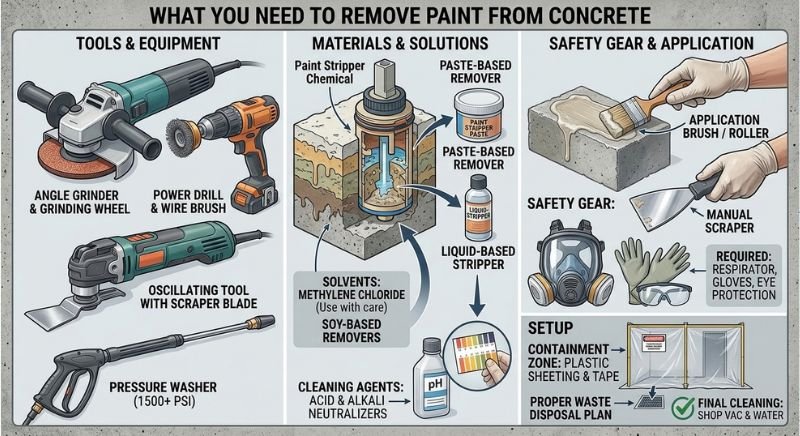
The supplies required depend on the size of the area and how firmly the paint is attached. A small spill may only require a scraper and stiff brush, while a large painted floor may need a concrete-safe stripper, pressure washer, or mechanical removal tool.
Basic Tools and Supplies
Start with basic tools before moving to more aggressive equipment. A sturdy scraper can lift peeling or softened paint, while a stiff nylon or wire brush can remove residue from the textured areas of the concrete.
You may also need a bucket, warm water, concrete-safe detergent, rags, absorbent material, a garden hose, and a wet/dry vacuum. For outdoor projects, a pressure washer can help with final cleaning and loosened paint removal.
If you are removing paint from a large floor, mechanical equipment can save considerable time. However, the tool should be appropriate for the concrete and used carefully so that you remove the coating without unnecessarily damaging the surface.
Paint Stripper and Concrete Paint Remover Options
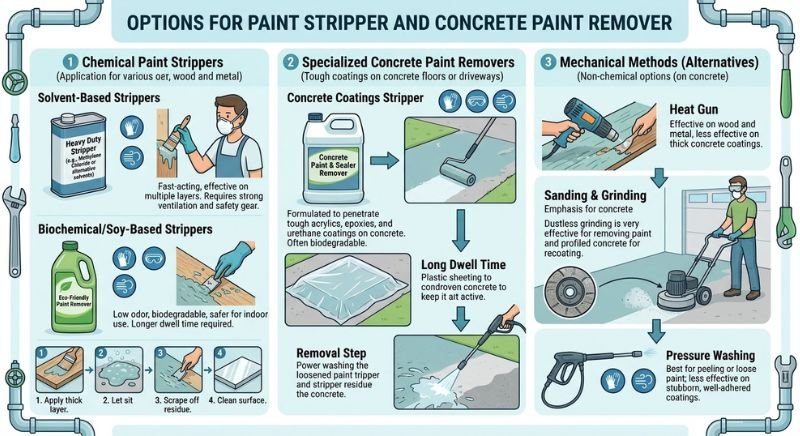
A paint stripper for concrete is designed to soften coatings so they can be scraped or scrubbed away more easily. Different products are formulated for different types of paint, so check the label before buying or applying one.
A concrete paint remover may come as a gel, paste, liquid, or other formulation. Thick products can be useful on vertical surfaces because they stay in place longer, while liquid products may be convenient for certain horizontal applications.
A concrete paint stripper should be selected according to the coating and substrate rather than simply choosing the strongest product available. Always follow the manufacturer’s instructions for application, dwell time, ventilation, protective equipment, and cleanup.
Safety Equipment to Wear
Paint removal can create dust, chips, chemical splashes, and contaminated water. Wear protective gloves and eye protection, and use suitable footwear with good traction while working.
If the process creates dust or fumes, use the respiratory protection and ventilation recommended for the specific product or equipment. Keep children and pets away from the work area, particularly when chemical strippers or pressure washers are involved.
Never mix paint removers, household cleaners, or other chemicals unless the manufacturer specifically confirms that they can be combined safely.
How to Remove Paint From Concrete Step by Step
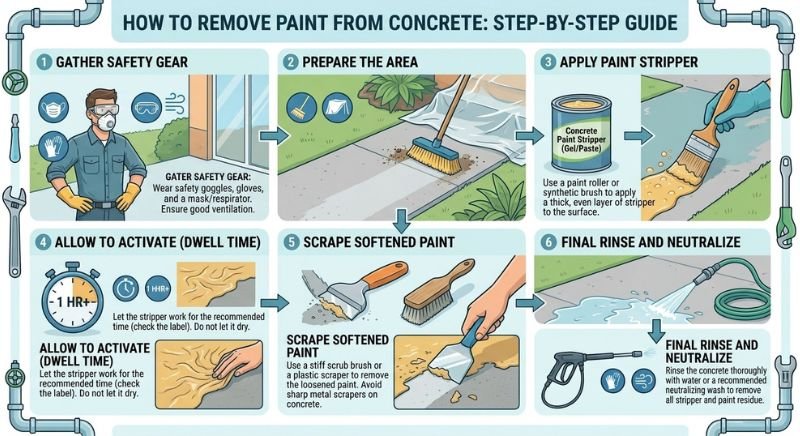
If you are wondering how to remove paint from concrete, start with the least aggressive approach that is likely to work. Cleaning and scraping should come before chemical stripping or heavy mechanical removal because loose paint can often be removed without stronger treatments.
1. Clean the Concrete Surface
Sweep or vacuum the area to remove dirt, dust, leaves, and loose debris. If the concrete has grease or oil on it, clean the contamination before applying a paint remover because oily residue can prevent the product from contacting the coating properly.
Use a suitable detergent and water when necessary, then allow the surface to dry as required by the removal method you plan to use. A clean surface makes it easier to see the paint and determine how firmly it is bonded.
2. Scrape Away Loose Paint
Use a scraper to lift paint that is peeling, cracked, blistered, or already separating from the concrete. Hold the tool at a controlled angle and avoid digging aggressively into the slab.
After scraping, use a stiff brush to remove flakes and smaller pieces. This can sometimes remove most of the coating from a small area without requiring a chemical product.
Scraping also gives you useful information about the condition of the paint. If it comes away easily, you may need only cleaning and light mechanical work. If it remains firmly attached, a stripper may be more appropriate.
3. Apply a Concrete Paint Stripper
When scraping leaves a firmly bonded coating behind, apply a product labeled for concrete or masonry and suitable for the type of paint you are removing. Spread the product according to its instructions rather than applying an unnecessarily thick layer.
Work in manageable sections, particularly on large floors or driveways. This gives you better control over the application and prevents the product from drying before you can remove the softened coating.
4. Let the Paint Remover Work
Allow the remover to remain on the paint for the manufacturer’s recommended period. Depending on the product, the coating may wrinkle, bubble, soften, or otherwise change as it breaks down.
Do not scrape prematurely if the instructions require more dwell time. Removing the product too soon can leave a stubborn layer behind and force you to repeat the entire process.
Outdoor conditions can also affect the result. Direct sunlight, high temperatures, wind, and rain may change how quickly the product works, so follow the manufacturer’s recommended conditions.
5. Scrub and Remove the Paint
Once the coating has softened, scrape it away and collect the waste rather than pushing it toward soil or drains. Use a stiff brush to work remaining residue out of the pores and textured areas.
If you are trying to understand how to get paint off concrete efficiently, this combination of softening, scraping, and brushing is often more effective than simply applying more pressure.
For textured concrete, work slowly because paint can remain in small depressions. Replace dirty water when necessary so that you are not spreading loosened paint back across the surface.
6. Rinse and Clean the Concrete
Rinse the concrete according to the instructions for the paint-removal product. Remove all visible stripper and loosened paint before judging the final result.
A pressure washer may be useful for outdoor concrete when the slab is sound and the equipment is operated at an appropriate pressure and distance. For indoor floors, controlled rinsing and wet collection are usually more practical because contaminated water needs to be contained.
Allow the concrete to dry completely before inspecting it. Wet concrete can hide remaining paint and make the surface appear cleaner than it actually is.
7. Repeat if Necessary
Thick or old coatings may not disappear after one treatment. If paint remains firmly bonded, repeat the approved treatment rather than immediately increasing pressure or switching to an aggressive mechanical method.
Several controlled applications can be preferable to excessive grinding or pressure. If the coating covers a very large area or consists of many layers, professional surface-preparation equipment may be worth considering.
How to Remove Spray Paint From Concrete
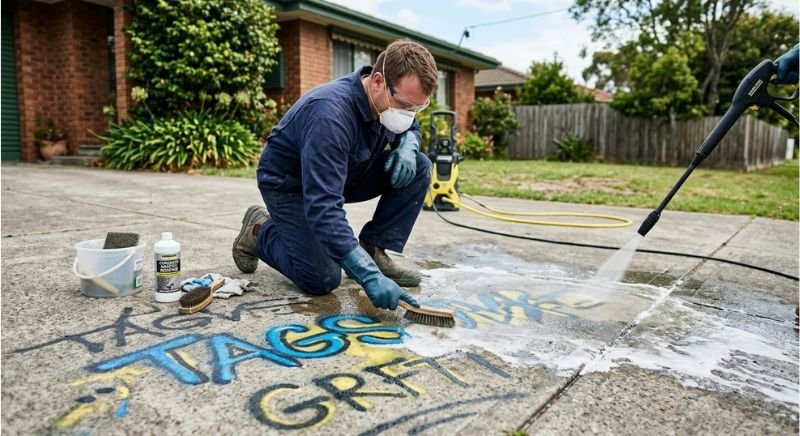
Spray paint can be challenging because the coating is often thin but can settle into the pores and texture of concrete. Fresh overspray is generally easier to deal with than paint that has been exposed to weather for a long period.
How to Get Spray Paint Off Concrete
If you need to know how to get spray paint off concrete, begin by cleaning the area and testing a small section with a suitable cleaner or paint remover. Light, relatively fresh spray paint may respond to scrubbing after the surface has been cleaned.
For cured spray paint, a compatible remover can soften the coating before scraping and brushing. A pressure washer may help outdoors, but excessive pressure can damage the concrete or spread contaminated water.
When spray paint is close to plants, walls, vehicles, drains, or other finished surfaces, protect those areas and control the runoff carefully.
How to Remove Spray Paint From Cement
The same general techniques used for concrete can apply when you are looking at how to get spray paint off cement, but the surface condition matters. Rough or porous cement-based surfaces can hold paint more deeply than smooth concrete.
Start with the least aggressive practical method. If brushing produces little improvement, test a suitable remover or mechanical method while watching for changes to the surface.
Removing Old or Stubborn Spray Paint
Old spray paint may require several stages because weathering can make the coating harder to loosen. Apply a compatible remover, allow it to work according to the instructions, and then scrape and scrub the softened paint.
If you are trying to learn how to take off spray paint from concrete that has been exposed outdoors for years, avoid assuming that maximum pressure is the answer. A combination of chemical softening and controlled mechanical cleaning can reduce the amount of force required.
For particularly stubborn coatings, professional abrasive or mechanical equipment may be appropriate. Such methods should be tested first because they can alter the texture of the concrete.
How to Remove Different Types of Paint From Concrete
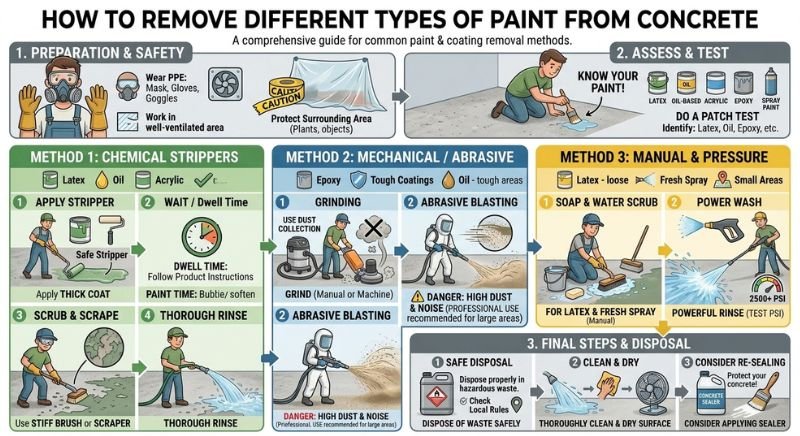
Paint chemistry affects how easily a coating can be removed. Knowing whether the paint is acrylic, latex, or another type can help you choose a method that is more likely to work on the first attempt.
How to Remove Acrylic Paint From Concrete
If you are looking for how to get acrylic paint off concrete, begin by determining whether the paint is fresh or fully cured. Fresh acrylic paint can often be removed with absorbent material, water, detergent, scraping, and scrubbing.
For cured acrylic, a product labeled for acrylic coatings may work better. Test the product first and follow the recommended dwell time rather than leaving it on the surface indefinitely.
When learning how to remove acrylic paint from concrete, remember that the condition of the concrete matters as much as the coating. Softer or weathered concrete should be treated more gently.
How to Remove Latex Paint From Concrete
Latex paint is water-based, so fresh spills are often easier to clean than fully cured coatings. Remove as much wet paint as possible before washing the area to prevent spreading it.
If you need to know how to remove latex paint from concrete after it has dried, start with scraping and scrubbing. A suitable paint remover can be used when mechanical cleaning does not provide enough progress.
Water alone may not dissolve a fully cured latex coating, so do not keep soaking the surface indefinitely if the paint remains unchanged.
How to Remove Old Paint From Concrete
When considering how to remove old paint from concrete, first inspect the coating for peeling, cracking, and multiple layers. Scrape away loose sections before treating the material that remains firmly bonded.
Older concrete can be more vulnerable to aggressive cleaning, particularly if it has already weathered or deteriorated. If the surface itself begins breaking down, reduce the intensity of the removal method.
How to Remove Thick or Multiple Layers of Paint
Several layers usually require more than one technique. Scrape loose upper layers, apply a suitable stripper to bonded material, and then remove the softened coating mechanically.
If you are learning how to strip paint off concrete with a thick coating, divide the project into manageable sections. This makes it easier to control the stripper and prevents sections from drying before the coating can be removed.
How to Remove Paint From Different Concrete Surfaces
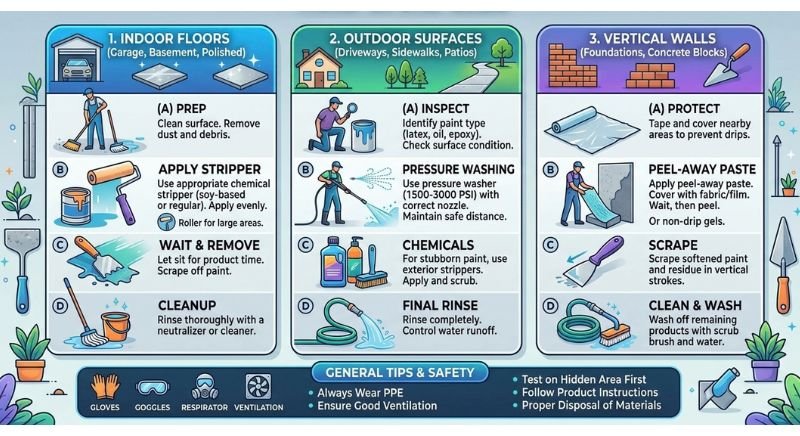
The basic removal process stays similar across most concrete surfaces, but the working conditions can change the best approach. Indoor floors require careful control of water, dust, and fumes, while porches and driveways demand more attention to weather and runoff. Before choosing a method, consider the paint type, the age of the coating, the texture of the concrete, and what you plan to do with the surface afterward.
How to Remove Paint From a Concrete Floor
When deciding how to remove paint from concrete floors, begin with dry methods whenever practical. Scrape away loose coating first, vacuum the debris, and then use controlled cleaning rather than flooding an indoor area with water. This approach is particularly useful when drainage is limited or the room has poor ventilation.
For firmly attached paint, test a concrete-compatible remover on a hidden section before treating the entire floor. After the coating has been removed, clean away stripper residue, paint particles, grease, and dust, then allow the slab to dry completely. A clean and dry surface is essential if you intend to apply a new coating.
How to Remove Paint From a Painted Concrete Floor
A painted concrete floor can be more complicated than a simple paint spill because the coating may have been intentionally designed as a floor finish. Before starting how to remove concrete paint from concrete, determine whether the entire coating actually needs to come off. If the existing finish is sound, repairing damaged areas and recoating may be more practical than stripping everything.
If complete removal is necessary, test your chosen process in an inconspicuous location. Older floors can contain several coatings applied at different times, so one section may soften quickly while another remains firmly bonded. This small test can reveal how the concrete and each coating layer respond before you commit to a larger area.
How to Remove Paint From a Garage Floor
Garage floors deserve extra preparation because oil, tire residue, road dirt, moisture, and previous coatings can interfere with paint removal. If you are working out how to clean paint off concrete in a garage, degrease contaminated areas before applying a stripper so the product can make proper contact with the coating.
For a small spill, a scraper and stiff brush may be sufficient. Large coated floors are different. If you are considering how to take paint off concrete across an entire garage, mechanical preparation can save considerable time, although grinders and similar equipment generate dust and may change the concrete’s surface profile.
If the floor has a dedicated coating system, understanding how to strip garage floor paint also means considering the next finish. Removing the visible paint is only part of the preparation; the slab must be clean, sound, and suitably profiled before another coating is applied.
How to Remove Paint From a Concrete Porch
If you are learning how to remove paint from concrete porch surfaces, start by protecting the areas that should remain untouched. Doors, siding, railings, decorative trim, plants, and nearby finished surfaces can all be affected by stripper, paint chips, or dirty rinse water.
Loose paint can often be lifted with a scraper before the remaining coating is treated. If a chemical remover is required, outdoor temperature, direct sunlight, wind, and rain can influence how long the product remains workable. Follow the manufacturer’s application conditions rather than extending the treatment simply because the paint has not loosened immediately.
How to Remove Paint From a Concrete Driveway
For anyone researching how to remove paint from concrete driveway surfaces, runoff deserves as much attention as the paint itself. A driveway gives you plenty of space for wet cleaning, but that does not mean contaminated water should be allowed to travel freely toward gardens, soil, neighboring property, or drainage systems.
Small paint spots are usually easier to control with targeted treatment than by stripping the entire driveway. Scrape away loose material, apply a suitable remover where needed, and work the softened coating out with a brush or scraper before carefully rinsing the area.
How to Remove Paint From Concrete Without Chemicals
Learning how to remove paint from concrete without chemicals is realistic when the coating is fresh, thin, peeling, or poorly bonded. Mechanical removal can also make sense where chemical use would create ventilation, runoff, or compatibility concerns. However, chemical-free does not automatically mean damage-free; excessive pressure or abrasion can remove part of the concrete surface along with the paint.
Scraping and Wire Brushing
Scraping is usually the most controlled starting point because it allows you to see exactly how strongly the coating is attached. Hold the scraper at a sensible angle and lift the paint rather than repeatedly digging the edge into the slab.
After scraping, use a stiff brush to work residue out of pores and textured sections. A wire brush can provide more aggressive action on durable concrete, but it may leave scratches or alter the appearance of decorative surfaces. Test it first, especially where the original texture needs to remain intact.
Pressure Washing
Pressure washing can be useful for outdoor paint removal, particularly after a coating has already been loosened. Start with moderate pressure and a suitable nozzle, keeping the wand far enough from the surface to avoid concentrating excessive force in one location.
A common mistake is assuming that more pressure means faster stripping paint from concrete. In reality, excessive pressure can remove the cement paste from the surface, expose aggregate, create visible cleaning patterns, or worsen existing damage. Move steadily and inspect the concrete as you work.
Using Heat or Mechanical Methods
Heat can soften certain coatings, while floor scrapers, grinders, abrasive systems, and other mechanical tools can deal with paint that resists hand removal. These methods are more demanding because they can generate dust, heat, sparks, noise, and debris.
Mechanical equipment is particularly useful on large floors where hand scraping would be inefficient. The important distinction is control. The objective of how to strip paint from concrete is not simply to remove the coating as quickly as possible; it is to remove the coating while keeping the underlying slab sound and usable.
When Chemical-Free Methods Work Best
Mechanical techniques tend to work best when paint is loose, thin, recently applied, or already failing. They are also practical for small spills and selected outdoor areas where dust and runoff can be managed properly.
When several layers have formed a dense, strongly bonded coating, repeated scraping may consume far more time and effort than necessary. In that situation, a compatible stripper can soften the coating first, reducing the amount of mechanical force needed afterward.
Can Vinegar Remove Paint From Concrete?
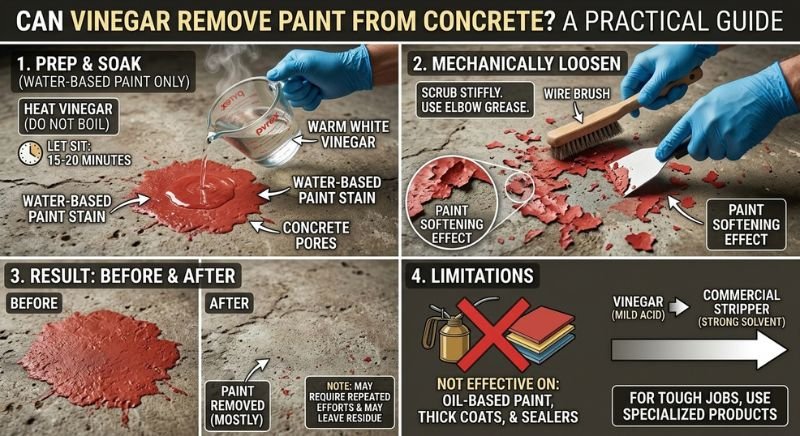
Vinegar is frequently mentioned as a household option for paint cleanup, but its usefulness is limited. It may help loosen some fresh or water-based residue, yet it should not be treated as a universal concrete paint remover. The chemistry and age of the coating matter considerably.
How to Use Vinegar for Paint Removal
If you want to test vinegar, first remove as much loose paint as possible with a scraper. Apply diluted vinegar to a small, inconspicuous section, allow limited contact time, and then scrub the area before rinsing it thoroughly.
This test is more useful than treating the entire surface immediately because it shows whether the particular paint actually responds. If there is little softening or lifting, continuing to soak the concrete is unlikely to transform vinegar into a heavy-duty remover.
Does Vinegar Work on Old or Stubborn Paint?
Vinegar is generally a poor choice for thick, aged, multilayer, or strongly bonded coatings. Paint that has cured and settled into the pores of concrete usually requires a method capable of softening or mechanically separating the coating.
For stubborn paint stripping on concrete, a purpose-made remover or controlled mechanical technique is usually more predictable. If the coating has been present for years, test the chosen method first because the concrete may be more vulnerable than it appears.
When to Use a Stronger Paint Remover
A stronger remover becomes reasonable when scraping, brushing, and mild cleaning produce little progress. Choose a product that specifically identifies concrete or masonry as a compatible surface and provides instructions for the type of coating you are dealing with.
Do not combine vinegar, bleach, household cleaners, or other chemicals with a commercial stripper unless the manufacturer explicitly states that they are compatible. If the paint type is unknown, a small test patch is safer than experimenting across the entire slab.
Best Paint Remover for Concrete: What to Look For
The best paint remover for concrete is not automatically the strongest product on the shelf. A good choice should match the coating, be appropriate for the concrete, suit the location of the project, and provide a realistic method for removing and disposing of the softened paint.
Best Paint Stripper for Concrete
When comparing products for stripping paint from concrete, read beyond the front label. Check which coatings the product is designed to remove, which surfaces it can be used on, how long it needs to remain in contact with the paint, and how the residue should be collected or washed away.
A gel or paste can be easier to control on vertical surfaces because it stays in contact with the coating. On large horizontal floors, coverage rate, dwell time, and ease of removal may become more important. The best choice is the one that fits the actual job rather than the one with the most aggressive claims.
Concrete Paint Stripper vs Chemical Paint Remover
These terms can overlap, so focus on compatibility instead of the terminology. A general chemical paint remover should not automatically be considered suitable for concrete simply because it removes paint from another material.
A product specifically labeled for concrete or masonry gives you clearer guidance about the substrate. Even then, check the technical information and perform a small test because concrete porosity, coating composition, and surface condition can vary substantially.
How to Choose a Paint Remover for Your Concrete Surface
Before buying a remover, consider the paint type, number of layers, surface location, condition of the concrete, ventilation, and cleanup requirements. A small acrylic spill on a porch has very different requirements from several layers of industrial-style floor coating in a garage.
If you are deciding how can I get paint off of concrete, the answer should begin with the surface rather than the product aisle. Identify what you are removing and what you are trying to preserve, then choose the least aggressive method with a reasonable chance of success.
What Removes Paint From Concrete?
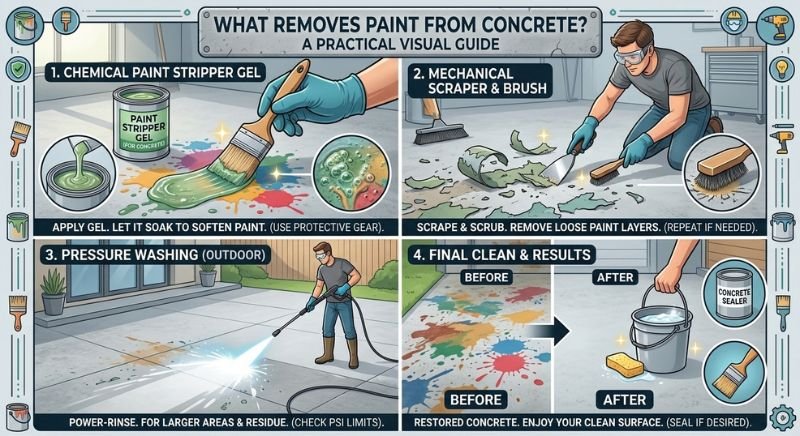
There is no single tool that works equally well on every coating. How do you remove paint from concrete successfully depends on whether the paint is loose, cured, porous, layered, sprayed, or deliberately applied as a floor coating.
Chemical Paint Strippers
Chemical strippers work by softening, swelling, or breaking down a coating so it can be separated from the concrete. They can be especially useful when several layers make ordinary scraping inefficient.
Product chemistry varies significantly, so follow the manufacturer’s instructions for application thickness, dwell time, ventilation, protective equipment, removal, and cleanup. A stripper that performs well on one paint system may be much less effective on another.
Scrapers and Wire Brushes
Scrapers are valuable because they provide precise mechanical action. They are particularly effective where paint has already begun peeling or where a chemical treatment has softened the coating.
Stiff and wire brushes can then reach residue left in pores and textured areas. The goal is controlled removal rather than brute force. If the brush begins changing the concrete faster than it removes the paint, switch techniques.
Pressure Washers
Pressure washers can be effective on outdoor concrete when paint has already been loosened. They can also help remove remaining residue after chemical treatment, provided the equipment is appropriate for the surface.
If you are trying to how to get paint out of concrete using pressure, remember that the visible paint is not the only thing at risk. Excessive pressure can damage the cement paste and force contaminated water into unwanted areas. Use controlled pressure and keep the nozzle moving.
Mechanical Paint Removal Tools
Floor scrapers, grinders, abrasive systems, and specialized surface-preparation equipment can remove firmly bonded coatings over substantial areas. They are often more practical than hand tools for large garage floors or heavily coated slabs.
Mechanical methods require proper dust control and equipment handling. Grinding can also create a different surface profile, which may be helpful before recoating but undesirable if the original appearance needs to be preserved.
Tips for Removing Stubborn Paint From Concrete
Difficult coatings rarely become easier simply because more force is applied. Effective removing paint from concrete usually comes from combining techniques intelligently: remove loose layers first, soften stubborn sections where appropriate, and finish with controlled mechanical cleaning.
Removing Several Layers of Paint
When several coatings are stacked on top of one another, treat them as separate layers rather than assuming one remover will affect everything equally. Scrape away loose upper material, test the remaining coating, and then select a compatible chemical or mechanical treatment.
If the layers contain different paint chemistries, you may notice that one layer softens while another remains almost unchanged. That response is useful information and can help you avoid wasting product across the entire surface.
Removing Paint That Has Been on Concrete for Years
Old paint can become strongly bonded while the concrete beneath it becomes weaker from weathering. Dirt, oil, moisture, freeze-thaw exposure, and repeated traffic can also change how the coating behaves.
When how to remove paint from concrete involves a years-old coating, inspect the slab before choosing an aggressive method. If the concrete itself begins flaking, powdering, or losing its surface paste, the removal technique is too aggressive and should be adjusted.
What to Do When Paint Won’t Come Off
When paint refuses to move, stop increasing pressure automatically. A coating that does not respond may need more manufacturer-approved dwell time, a remover designed for a different paint chemistry, or a mechanical approach better suited to its bond.
A small test patch can answer these questions without putting the entire surface at risk. This is particularly useful when you are unsure how do you get paint off of concrete that has been painted repeatedly or exposed to years of weather and traffic.
How to Avoid Damaging the Concrete
The best way to strip paint from concrete is to remove the coating while taking as little of the underlying surface as possible. Begin with the mildest method that has a realistic chance of working, then increase intensity only when the concrete tolerates it.
Avoid keeping a grinder, pressure-washer nozzle, or aggressive wire brush concentrated in one spot. If the concrete starts looking lighter, rougher, or more textured while the paint remains, stop and reassess the method rather than continuing until the coating finally disappears.
Common Mistakes to Avoid When Removing Paint From Concrete
Many failed paint-removal projects are not caused by an impossible coating. They happen because the removal process is too aggressive, the surface was not prepared, or the product was chosen without considering the paint and concrete together.
Using Too Much Pressure
Pressure can remove paint, but it can also remove the surface of the concrete. Weathered slabs are particularly susceptible to etching, exposed aggregate, and visible spray patterns.
Start conservatively and increase pressure only after a test area shows that the concrete can tolerate it. The fastest-looking method is not necessarily the one that leaves the best finished surface.
Choosing the Wrong Paint Remover
A remover designed for one coating may perform poorly on another. Selecting a product solely because it says “paint remover” can lead to disappointing results or unnecessary cleanup.
Check both sides of the compatibility equation: the product must be appropriate for the concrete and suitable for the paint. If possible, test it before committing to a large section.
Skipping the Surface Test
A small test patch can reveal whether the paint will soften, whether the concrete changes appearance, and whether the resulting residue can be managed. It is one of the simplest ways to reduce the risk of turning a manageable job into a surface-repair project.
This matters particularly for decorative concrete, older slabs, previously coated floors, and surfaces where the final appearance is important.
Failing to Rinse the Concrete Properly
After paint removal from concrete, the remaining residue can be just as important as the coating itself. Follow the product’s instructions for removing stripper, paint particles, and other contaminants rather than assuming a quick rinse is enough.
If the concrete will be recoated, leftover stripper, grease, dust, or paint can interfere with adhesion. Outdoors, also control contaminated water carefully so the cleanup does not simply transfer paint and chemicals from the concrete to surrounding soil or drainage areas.
Final Thoughts on Removing Paint From Concrete
Effective paint stripping on concrete is less about finding the strongest remover and more about understanding what is actually bonded to the slab. A fresh spill, spray-painted mark, acrylic coating, latex paint, and aged garage-floor finish can behave very differently. Starting with surface inspection and a small test area often tells you more than immediately choosing an aggressive tool.
If you are deciding how to remove paint off concrete, use a progression rather than a single-force approach. Lift what is loose, clean what is underneath, soften stubborn coating when appropriate, and then use controlled scraping, brushing, pressure, or mechanical preparation. This approach reduces unnecessary wear on the concrete and gives you better control over the finished surface.
For removing paint on concrete, the condition of the slab deserves as much attention as the paint itself. Weathered, porous, decorative, cracked, or previously damaged concrete may not tolerate the same treatment as a sound commercial slab. A method that removes paint quickly can still be a poor choice if it leaves behind gouges, etched areas, exposed aggregate, or an uneven surface.
The final stage matters, too. After the removal of paint from concrete, remove residual stripper and coating debris according to the product instructions, allow the surface to dry thoroughly, and inspect it under good lighting. If you plan to repaint or apply a new coating, the concrete needs to be clean and appropriately prepared rather than merely free of visible paint.
FAQs
How do you get paint off concrete?
If you are figuring out how do you get paint off concrete, do not begin by attacking the surface with maximum pressure. First identify whether the paint is a fresh spill, a cured decorative coating, spray paint, or several old layers. Scrape anything loose, clean the surface, and test a small area with the least aggressive method that could reasonably work. Firmly bonded coatings can then be treated with a concrete-compatible stripper before scraping, brushing, and rinsing.
What is the best way to get paint off concrete?
The best way to get paint off concrete depends on the bond between the coating and the slab. A thin latex spill may need only scraping and washing, while an aged floor coating may require chemical softening followed by mechanical removal. Porosity also matters: paint lodged deep in textured concrete can require repeated brushing even after the visible film has disappeared. The objective is to remove the coating without taking the concrete surface with it.
What takes paint off concrete?
If you are asking what takes paint off concrete, the practical choices include scrapers, stiff brushes, compatible chemical strippers, pressure washers, floor scrapers, grinders, and other mechanical preparation tools. Their usefulness varies by situation. A scraper is excellent for lifting curled edges, a stripper can soften stubborn films, and controlled mechanical equipment can handle large coated areas. Pressure washing is generally more useful outdoors and should be controlled carefully to avoid etching the slab.
How do you remove concrete paint?
If you want to know how to remove concrete paint from concrete, first determine whether the existing coating is supposed to be there. A painted garage floor, for example, may have an intentional coating system rather than accidental paint contamination. If complete removal is required, clean the surface, remove loose sections, test a compatible stripper or mechanical method, and work in manageable sections. Different layers may react differently, particularly on older floors that have been recoated over time.
Can you remove paint from concrete without chemicals?
Yes, but how to remove paint from concrete without chemicals depends heavily on the coating’s condition. Scraping and wire brushing can handle loose or poorly bonded paint, while pressure washing can help with outdoor surfaces after the coating has been loosened. Mechanical methods such as floor scraping or grinding are more suitable for substantial areas, although they generate dust and can alter the concrete’s texture. Chemical-free removal is not automatically gentler; excessive abrasion can permanently change the surface.
Will vinegar remove paint from concrete?
Vinegar is sometimes suggested as a household option, but will vinegar remove paint from concrete? It may help with some fresh, water-based residue, but it is not a dependable solution for cured floor coatings, thick acrylic films, or old paint. If you experiment with vinegar to remove paint, use a small test patch rather than soaking the entire surface. If there is little change after testing, a product formulated for the specific coating is generally a more sensible choice.
How do you remove old paint from concrete?
When learning how to remove old paint from concrete, treat age as a clue rather than assuming every old coating needs the same treatment. Years of weather exposure can make paint brittle and layered, while traffic and oil contamination can complicate garage-floor coatings. Begin by removing loose material, then test a suitable stripper or mechanical technique. If the concrete starts shedding its own surface paste or aggregate becomes exposed, stop and reduce the aggressiveness of the process.
Can you remove paint from a concrete driveway?
Yes, but removing paint from concrete outdoors requires more than simply getting the visible coating off. A driveway can often be treated with scraping, a compatible remover, controlled pressure washing, or a combination of methods. Pay close attention to runoff because softened paint, stripper residue, and contaminated wash water should not simply be pushed toward landscaping or drainage systems. For a small spill, targeted treatment is usually easier to control than applying a remover across the entire driveway.