

Painting a room often feels like a job you can finish in one afternoon. The first coat goes on smoothly, the color starts to look right, and then comes the awkward part: waiting. If you paint the next layer too soon, you can disturb the finish you just worked on. If you wait longer than needed, you may wonder if you have made the job harder.
So, how long to wait between coats of paint? For most interior latex and water-based paints, a good starting point is around 2 to 4 hours. Oil-based paint usually needs much longer, often 8 hours or more. These are only general ranges, though. The paint formula, room temperature, humidity, airflow, surface, and thickness of the coat can all change the actual wait time.
How Long Should You Wait Between Coats of Paint?
For a typical water-based interior wall paint, the how long between coats of paint question usually has a 2-to-4-hour answer when the room has normal temperature and humidity. Some products dry faster, while others need more time, so the label on your paint can should always be your first reference.
It is also worth knowing that paint can feel dry before it is ready for another layer. A surface may no longer feel wet but can still be soft underneath. Waiting for the stated recoat time gives the first layer enough time to settle before you work over it again.
Typical Recoat Time
If you are trying to work out how long to wait between paint coats, start by identifying the type of paint you are using. Water-based paints often have shorter recoat windows, while oil-based formulas tend to take longer.
A typical interior project may look something like this:
| Paint type | Common recoat range |
| Latex or water-based | 2–4 hours |
| Acrylic | 2–4 hours |
| Oil-based | 8–24 hours |
| Specialty coatings | Follow product instructions |
These ranges are only useful as a starting point. The actual time between coats of paint can change when the room is cold, damp, poorly ventilated, or when the first layer was applied too heavily.
Dry-to-Touch vs. Recoat Time
One of the easiest ways to get into trouble is to treat “dry to touch” and “ready to recoat” as the same thing. They are not. Dry-to-touch means the surface no longer feels wet when lightly touched. Recoat time is the period recommended before another layer is applied.
That difference explains why how long should paint dry between coats does not have one universal answer. A paint that feels dry after an hour may still need another hour or two before you can safely roll over it.
Why You Should Follow the Paint Manufacturer’s Recommended Time
Paint makers test their formulas and provide recoat instructions based on how the product is designed to perform. Those instructions are more useful than a generic rule found online because two paints with the same basic finish can have very different drying characteristics.
If the can says four hours, there is little benefit in trying to beat the clock. Giving the first coat its recommended time is usually easier than fixing a surface that was disturbed because the next coat went on too early.
How Long Does Paint Need to Dry Before a Second Coat?
The answer to how long to let paint dry before second coat depends on both the product and the conditions around it. A warm room with moderate humidity and good air movement will usually give you a better drying environment than a cold, closed-up room.
Before applying another layer, look at more than the clock. The surface should be firm, free from tackiness, and ready to accept another pass without pulling or dragging.
How Long to Wait for a Second Coat of Paint
When deciding how long to wait for a second coat of paint, use the manufacturer’s recoat time as your baseline. For many water-based wall paints, that means roughly 2 to 4 hours under normal conditions.
If the room is humid or the first coat is unusually thick, waiting longer is sensible. A little extra drying time rarely causes harm, while rushing a soft coat can leave you with marks that are much harder to hide.
How to Tell When Paint Is Ready for the Second Coat
Knowing how long to wait before second coat of paint is easier when you combine the label instructions with a quick surface check. Lightly touch an inconspicuous area. The paint should not feel sticky, rubbery, or soft.
Look closely at corners and places where paint may have collected. These areas can stay wet longer than the middle of the wall. If your roller starts pulling at the first coat instead of gliding over it, stop and give the surface more time.
What Is the Difference Between Dry Time and Recoat Time?
Drying is a process rather than a switch that flips from wet to dry. The surface may dry first while the paint underneath continues to lose moisture or harden.
That is why how long does paint need to dry between coats should be answered using the product’s recoat guidance rather than touch alone. Recoat time is meant to tell you when the paint is ready to receive another layer without being easily disturbed.
How Long Between Coats of Paint on Walls?
For a standard interior wall painted with water-based paint, the usual recoat window is around 2 to 4 hours. However, how long to wait between paint coats on wall surfaces can vary from room to room.
A sunny bedroom, a steamy bathroom, and a chilly basement can all have different drying conditions. The paint may be identical, but the environment can change the result.
Interior Wall Paint Recoat Time
When asking how long to wait between coats of paint on walls, pay attention to the specific product you bought. Interior wall paints are often designed for fairly quick recoating, but the label may give a different figure depending on the formula.
Large walls also deserve a quick inspection before you start. Areas near windows may dry differently from corners or sections behind doors where air movement is limited.
How Humidity and Temperature Affect Wall Paint Drying
Humidity is one of the biggest reasons paint takes longer than expected. Water-based paint releases moisture as it dries, and damp air makes that process slower. A room with high humidity can therefore extend how long for wall paint to dry between coats.
Temperature matters as well. Paint usually performs best within the range stated on the label. Very cold conditions can slow drying, while excessive heat can cause the surface to dry too quickly and make application harder.
When to Give Wall Paint Extra Drying Time
Give the paint additional time when the room feels damp, the temperature is low, or the first coat was applied heavily. Poor airflow is another reason to be patient.
In these situations, how long to wait in between coats of paint may be longer than the number printed on the label under ideal conditions. The goal is not to hit an exact hour mark; it is to give the coating enough time to become stable.
Paint Recoat Time by Paint Type
The kind of paint you use has a major effect on how long to wait before painting a second coat. Water-based products generally dry faster, while oil-based coatings need more time because their drying process is different.
Latex and Water-Based Paint
Latex and other water-based paints are common choices for walls because they are relatively quick to dry and easy to work with. Under normal indoor conditions, many can receive another coat after about 2 to 4 hours.
Even within this category, though, formulas differ. If you are wondering how long should i wait between paint coats, check the specific product rather than assuming every can follows the same schedule.
Acrylic Paint
Acrylic paint can also have a relatively short recoat period, but its drying speed depends on the formulation and the conditions around it. A thin layer in a warm, dry room may become ready sooner than a heavy coat in a humid space.
This is why a general answer to how long to dry between coats of paint should always be treated as an estimate rather than a promise.
Oil-Based Paint
Oil-based paint generally takes longer to dry than water-based paint. Depending on the product and conditions, you may need to wait 8 to 24 hours before applying another coat.
If you are working with oil-based paint, resist the temptation to speed things up simply because the surface looks dry. The deeper layer may still be soft.
How Paint Formulation Affects Recoat Time
Paint is not one-size-fits-all. Different resins, solvents, pigments, and additives can change how quickly a coating dries and when it becomes ready for another layer.
That is why dry time between paint coats should be based on the product you are actually using. A fast-dry trim paint, wall paint, cabinet enamel, and oil-based coating may all have different instructions.
What Factors Affect the Time Between Paint Coats?
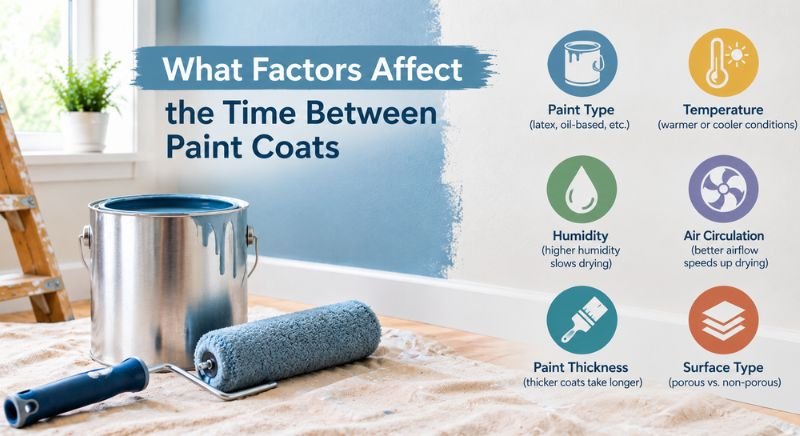
The label gives you a useful starting point, but the room itself can change how much time between paint coats you really need.
Temperature
Cool air can slow the drying process, which means a coat that normally becomes ready in a few hours may need longer. Always check the manufacturer’s recommended application temperature before painting.
Humidity
High humidity slows moisture loss from water-based paint. This is particularly noticeable in bathrooms, kitchens, laundry rooms, and other spaces where moisture levels can rise.
Ventilation and Airflow
Fresh air and gentle circulation can help paint dry more evenly. Keeping a room completely closed can trap moisture, but blasting a strong fan directly at wet paint is not a good shortcut.
Aim for steady, moderate airflow rather than trying to force the paint dry.
Thickness of the First Coat
More paint means more material that has to dry. Applying an overly thick first coat can leave the surface dry on top while the lower part remains soft.
A thin, even coat generally gives you a more predictable how long to wait to paint second coat situation.
Surface Material and Condition
Paint behaves differently on drywall, wood, previously painted surfaces, metal, and other materials. A porous surface may absorb some of the coating, while a sealed surface can leave more paint sitting on top.
Surface preparation also matters. Dirt, grease, moisture, or a poorly bonded old coating can interfere with how the new paint dries and adheres.
How to Know If Paint Is Ready for Another Coat
The clock is useful, but your eyes and fingertips can tell you a lot too. If you are unsure how long should i let paint dry between coats, inspect the surface before opening the paint can again.
Check if the Surface Is Dry to the Touch
Touch a small area gently with a clean finger. It should feel dry rather than sticky or soft. Do not press hard because a partially cured coating can still mark easily.
Remember that touch-dry is only one clue. The manufacturer’s recoat time still matters.
Look for Tackiness, Glossy Spots, or Soft Areas
Pay attention to areas that look unusually glossy or feel different from the rest of the wall. Thick spots around corners, brush edges, and drips can take longer to dry.
If the paint feels tacky when you lightly touch it, wait. Applying another layer over that area can create a finish that looks uneven once it finally dries.
Check the Manufacturer’s Recommended Recoat Time
When deciding how long to let paint dry between coats, compare what you see on the wall with the time listed on the can. If the label says four hours and the room is cool and humid, there is no need to force the issue at exactly four hours.
The manufacturer’s number is a guide under expected conditions, not a countdown timer.
Should You Sand Between Coats of Paint?
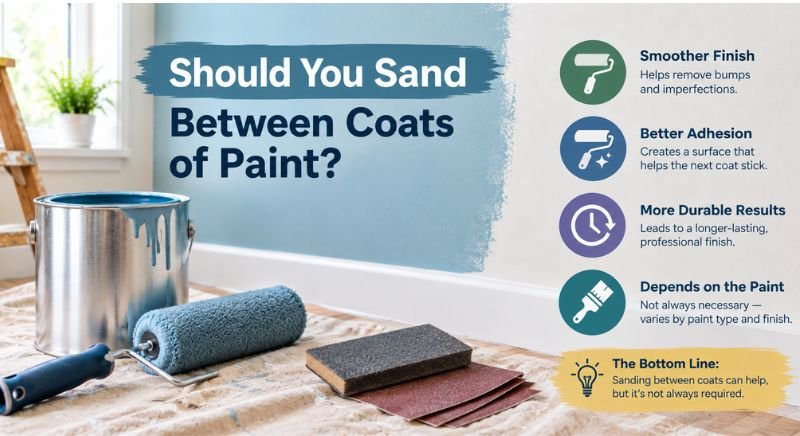
The answer to should you sand between coats of paint depends on the condition of the first coat and the finish you want. For many smooth interior walls, sanding between every coat is unnecessary. For trim, cabinets, furniture, or a high-end finish, light sanding can make a noticeable difference.
When Sanding Between Coats Is Recommended
Sanding is useful when the first coat has small bumps, dust particles, rough patches, dried drips, or visible texture. A light pass with fine-grit sandpaper can smooth those flaws before the next layer goes on.
It is especially helpful when you want a very smooth finish on doors, cabinets, woodwork, or furniture.
When You Can Skip Sanding
If the first coat is smooth, clean, well bonded, and the paint instructions do not call for sanding, you can often move straight to the next coat.
For a basic wall repaint, sanding every layer can add time without giving you a meaningful improvement.
How to Sand Between Paint Coats Without Damaging the Finish
Use fine-grit sandpaper and a light touch. You are not trying to remove the first coat; you are simply knocking down tiny imperfections.
Once finished, remove all sanding dust before painting again. Even a small amount of loose dust can become trapped in the fresh coat and leave a rough texture.
What Happens If You Apply the Second Coat Too Soon?
Rushing the second coat may seem like a good way to finish the job faster, but it can create problems that take much longer to fix. When the first coat has not dried enough, the roller or brush can disturb the paint underneath instead of gliding smoothly across the surface. The result may look fine at first and then reveal flaws as the paint settles and cures.
If you are unsure how long to wait before 2nd coat of paint, it is safer to give the first layer a little more time than to risk damaging it. A few extra hours are usually easier to handle than sanding, repainting, or correcting an uneven finish.
Peeling and Poor Adhesion
Paint needs enough drying time to form a stable bond with the surface. When another coat is applied while the first one is still soft, the two layers may not bond as they should. Later, the paint can begin to lift, peel, or separate, especially on areas that receive frequent touching, cleaning, or moisture.
Poor adhesion can also become more noticeable around corners, trim, doors, and other high-use areas. If the first coat feels sticky or comes away slightly when rubbed, it is a clear sign that the surface needs more drying time before you continue.
Wrinkling and Uneven Finish
Applying fresh paint over a soft first coat can cause the lower layer to move when the roller passes over it. Instead of leaving a smooth surface, the new coat may create wrinkles, ridges, ripples, or areas with different levels of sheen.
This problem is particularly frustrating because it may not be obvious while the paint is wet. As the coating dries, the disturbed areas can become much easier to see. If you notice the roller dragging rather than rolling smoothly, stop and allow the surface to dry longer.
Brush and Roller Marks
A properly dried first coat gives your brush or roller a stable surface to work over. When it is still soft, the tool can pull, smear, or partially lift the paint underneath. This can leave visible roller lines, brush marks, thin patches, or small areas where the first color shows through.
Instead of trying to correct these marks with more paint, let the surface dry completely first. Once it is firm, you can lightly smooth any rough spots and apply the next coat with much better control.
Longer Overall Curing Time
Two coats applied too close together can leave more moisture trapped within the layers. The surface may appear finished, but the paint can remain soft underneath for longer than expected. This can delay the point at which the wall is safe to wash, scrub, touch frequently, or place objects against.
In other words, finishing the painting sooner does not always mean the paint will be ready for normal use sooner. Giving each coat enough drying time usually leads to a more predictable and durable finish.
What Happens If You Wait Too Long Between Coats?
Waiting longer than the recommended recoat period is generally less risky than painting over a coat that is still wet or soft. If you stop for the evening and continue the next day, the paint does not automatically become unusable. In many cases, a fully dry coat can sit for quite some time before the next layer is applied.
The important question is what happened to the surface while you were away. Dust, grease, moisture, fingerprints, and other debris can settle on a wall, particularly in kitchens, hallways, workshops, and other busy areas. A quick inspection before recoating can prevent those small problems from becoming part of the final finish.
When Additional Surface Preparation Is Needed
If the first coat has been exposed for several days or longer, inspect it carefully before painting again. Look for dust, grease, loose particles, peeling areas, or anything that could interfere with adhesion. A dirty surface should be cleaned, while rough or damaged areas may need light sanding and repair.
Long gaps can also matter when the product has specific recoat instructions. Some coatings recommend sanding after a certain period before another coat is applied. If you have left the project for much longer than planned, check the paint manufacturer’s instructions rather than assuming the next coat can go straight on.
When You Can Simply Apply the Next Coat
If the first coat is clean, smooth, fully dry, and firmly attached, there is usually no reason to start the entire painting process again. Remove any surface dust, check for imperfections, and continue with the next coat.
A delayed painting project is rarely a problem by itself. In fact, a properly prepared dry surface is generally a much better foundation for fresh paint than a surface that was recoated too early. Take a few minutes to inspect the wall before deciding whether any extra preparation is needed.
How to Apply the Second Coat of Paint Properly
Once the first coat has reached its recommended recoat time, the next step is not simply to roll more paint over it. A quick inspection and a controlled application can make the second layer smoother, more even, and easier to finish.
The second coat is often where the final color becomes richer and coverage becomes more consistent. Taking a little care at this stage can also help hide minor variations left by the first application.
Inspect and Prepare the First Coat
Before opening the paint can, walk around the room and inspect the entire surface under good lighting. Look for missed sections, drips, rough patches, small bubbles, dust particles, or areas where the coverage appears thinner than the rest.
Small imperfections are much easier to correct before the second coat goes on. If you find a drip, for example, sanding it smooth now is far easier than trying to hide it under another layer of wet paint.
Lightly Sand if Necessary
Sanding is not required between every coat, particularly on smooth interior walls. However, if the first coat has a rough texture, dried particles, or small imperfections, a light pass with fine-grit sandpaper can help create a smoother base.
Use gentle pressure and avoid removing large amounts of paint. The goal is simply to knock down small flaws. Once finished, make sure all sanding dust is removed before applying the next coat.
Remove Dust and Debris
Dust is easy to overlook, but even small particles can become trapped in fresh paint and leave a gritty or bumpy finish. After sanding or cleaning, give the surface enough time to become free of loose debris before you start painting.
Use a clean, suitable cloth or the cleaning method recommended for the surface and paint. Pay extra attention to corners, window ledges, baseboards, and other places where dust tends to collect.
Apply a Thin, Even Second Coat
Apply the second coat with steady, even strokes rather than trying to cover everything with one heavy application. Too much paint at once can lead to runs, drips, uneven sheen, and longer drying time.
Work in manageable sections and keep a wet edge as you move across the wall. Avoid repeatedly rolling over areas that have already started to dry, since doing so can create visible texture or uneven coverage.
Allow the Final Coat to Cure
After the final coat is applied, remember that dry and fully cured are different stages. Paint may feel dry relatively soon but continue hardening underneath for several days, depending on the product and conditions.
During this period, avoid heavy cleaning, scrubbing, frequent touching, or placing objects directly against the freshly painted surface unless the manufacturer’s instructions say it is safe. Giving the final coat time to cure helps the finish reach its intended hardness and durability.
Common Mistakes That Affect Paint Recoat Time
Getting the timing right is only part of a successful paint job. The way paint is applied and the conditions in the room can have just as much influence on drying. Many problems blamed on “bad paint” actually come from thick application, poor airflow, high humidity, or simply not following the product instructions.
A few small changes in your approach can make the drying process more predictable and reduce the chance of having to redo the work.
Recoating Based Only on Touch-Dry Time
One of the most common mistakes is touching the wall, finding that it feels dry, and immediately applying another coat. Touch-dry only tells you that the surface has dried enough not to feel wet. It does not necessarily mean the layer underneath is ready for another coat.
Use touch as a quick check, but compare it with the manufacturer’s stated recoat time. If the paint feels soft, tacky, or unusually cool in certain areas, give it more time even if the recommended window has already passed.
Applying Paint Too Thickly
A heavy coat may seem like a shortcut because it can provide more coverage in one pass. In reality, thick paint contains more material that needs to dry and can create runs, sags, soft spots, and uneven sheen.
Thin, even coats usually dry more consistently and make it easier to achieve a clean finish. If the first coat does not provide complete coverage, it is generally better to let it dry properly and build coverage with the next coat rather than trying to solve the problem with one oversized application.
Painting in High Humidity
High humidity can noticeably slow the drying of water-based paint because moisture has a harder time leaving the coating. This is why a wall painted on a damp day may still feel soft long after a similar coat dried quickly under drier conditions.
If the room is humid, allow extra drying time and improve gentle air circulation when possible. Avoid creating a strong draft directly over wet paint, since extremely fast surface drying can also affect how evenly the coating settles.
Ignoring the Manufacturer’s Instructions
General drying estimates can help you plan a project, but they should never replace the instructions on the paint can. Different formulas can have different recoat times, application temperatures, humidity limits, and curing requirements.
If the product says to wait four hours, treat that as your starting point. If the conditions are colder, wetter, or less ventilated than normal, the actual wait may need to be longer. The label is written for the specific coating you are using, which makes it more reliable than a general rule.
Poor Ventilation
A room with little air movement can hold moisture around freshly painted surfaces and slow drying. This is especially noticeable in bathrooms, basements, kitchens, and rooms with closed windows and doors.
Good ventilation does not mean blasting the paint with a powerful fan. Instead, aim for gentle, steady airflow that helps moisture leave the room. If appropriate for the space and weather, opening a door or window can improve circulation and create more consistent drying conditions.
Quick Guide to Paint Drying and Recoat Times
| Paint type | Typical dry time | Typical recoat time | Important considerations |
| Latex/water-based | 1–2 hours | 2–4 hours | Humidity and thick coats can extend drying |
| Acrylic | 1–2 hours | 2–4 hours | Product formula and room conditions matter |
| Oil-based | 6–8+ hours | 8–24 hours | Needs more drying time and good ventilation |
| Specialty paint | Varies | Varies | Follow the manufacturer’s instructions |
These are broad estimates rather than fixed rules. Actual drying can change with temperature, humidity, airflow, surface type, and how heavily the paint was applied.
Conclusion
Getting the timing right is less about watching the clock and more about understanding what the paint is doing. For many water-based interior products, waiting 2 to 4 hours is a reasonable starting point, while oil-based paint may need most of a day before another coat.
Temperature, humidity, airflow, surface condition, and coat thickness can all stretch that window. When conditions are less than ideal, giving the paint more time is usually the safer choice.
Most importantly, don’t let a dry-looking surface trick you into rushing. Follow the product’s recoat instructions, check the surface before working over it, prepare any rough areas, and applone next coat evenly. A patient approach may add a little waiting time, but it can save you from fixing peeling, wrinkles, roller marks, and uneven coverage later.
FAQs
How long should you wait between coats of paint?
For many interior water-based paints, 2 to 4 hours is a common recoat window. Oil-based products often need 8 hours or more, but the product label should always take priority.
How long should paint dry between coats?
Paint should be dry enough to accept another layer without becoming soft or tacky under the roller. The manufacturer’s recommended recoat time is a better guide than touch alone.
How long should you wait before a second coat of paint?
If you are wondering how long to wait before a second coat of paint, check the label first. Many latex paints need about 2 to 4 hours, while oil-based formulas generally require longer.
How long between coats of paint on a wall?
For common water-based wall paint, around 2 to 4 hours is typical under normal indoor conditions. A cool, humid, or poorly ventilated room may require more time.
Can you apply a second coat when the first coat feels dry?
Not always. The surface can feel dry while the layer underneath remains soft. Check the recommended recoat period and make sure the paint is not tacky before continuing.
Should you sand between coats of paint?
Not necessarily. Smooth interior walls often do not need sanding between coats, while trim, cabinets, furniture, and surfaces with small imperfections can benefit from light sanding.
What is the maximum time you can wait between coats of paint?
There is no universal maximum. If the first coat has remained clean and intact, you can often continue later. After a long delay, inspect and clean the surface and sand lightly if needed.