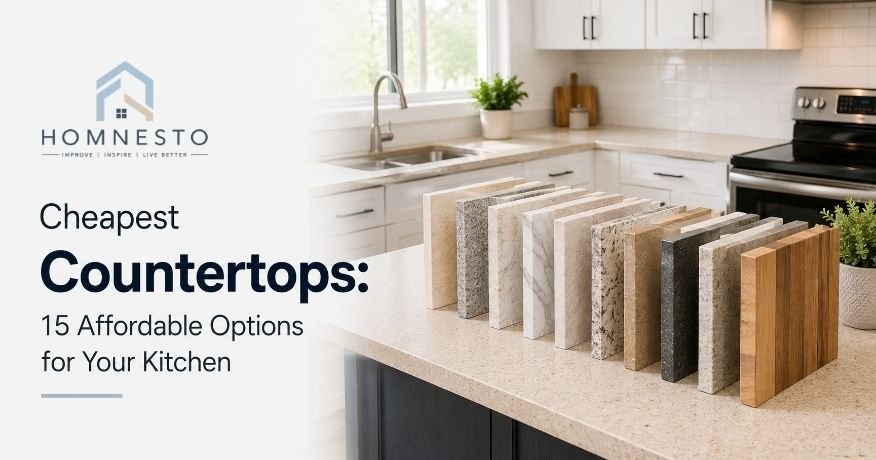

Replacing a kitchen countertop can change the whole room without requiring a full kitchen remodel. However, the cheapest countertop material is not always the cheapest choice once you add fabrication, delivery, installation, sink cutouts, and other project costs. A material that costs less per square foot may require more labor or maintenance later.
The best approach is to compare the complete project, not just the price tag on the material. Laminate, tile, butcher block, solid surface, remnants, and refinished counters can all work well for different budgets. The right choice depends on how much you can spend, how heavily you use your kitchen, and how long you want the countertop to last.
15 Cheapest Countertop Options for Your Kitchen
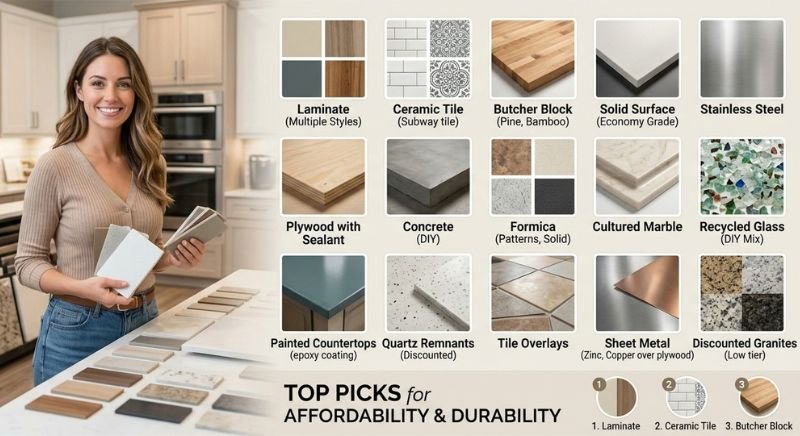
There is no single winner for every kitchen. Some materials have a low material price, while others become affordable because they are easy to install or available as remnants. Your location, countertop size, layout, material quality, fabrication, and labor can all change the final bill.
1. Laminate Countertops
Laminate is often the first material to consider when shopping for cheap countertops. It offers many colors, patterns, and stone-look finishes without the price of natural stone. Current U.S. estimates commonly place laminate around $10 to $40 per square foot, depending on quality and installation.
For a busy household, laminate works best when you treat it as a practical surface rather than an indestructible one. It resists everyday stains fairly well, but sharp knives, excessive heat, and standing water can damage it. It also cannot usually be repaired as invisibly as stone.
For homeowners who want affordable kitchen countertops with a clean appearance, laminate offers a strong balance of price and style. Modern patterns can imitate marble, wood, and other materials surprisingly well. It is especially useful when keeping the existing countertop layout can reduce installation work.
2. Tile Countertops
Tile can be one of the least expensive countertop materials, particularly when you are comfortable handling some of the work yourself. Ceramic tile can cost only a few dollars per square foot for the material, although the complete project costs more after substrate preparation, edging, grout, and labor.
Tile gives you almost unlimited design freedom. You can mix colors, patterns, borders, and textures to create cheap countertop ideas that feel custom rather than basic. The main drawback is grout. Grout lines collect crumbs and stains and need regular cleaning.
Tile is particularly attractive for homeowners searching for affordable DIY countertops or DIY countertops on a budget. Just make sure the surface underneath is stable and properly prepared.
3. Ceramic Tile Countertops
Ceramic tile deserves its own mention because it can be extremely affordable while offering plenty of design choices. HomeAdvisor currently lists ceramic countertop material around $5 to $7 per square foot, although installation can raise the total substantially.
Ceramic works well for smaller kitchens, utility areas, rental upgrades, and homeowners who want a decorative surface without paying for a slab. You can choose simple white tile for a clean look or patterned tile for more character.
The trade-off is maintenance. The tile itself can perform well, but grout requires attention. Uneven tile surfaces can also make rolling appliances or preparing certain foods less convenient.
4. Porcelain Tile Countertops
Porcelain tile costs more than some basic ceramic options, but it can offer better resistance to heat, moisture, and everyday wear. Depending on the product, porcelain can also create a convincing stone or concrete appearance.
Current cost guides place porcelain tile among the more affordable countertop choices, although installed prices vary widely based on tile size and installation complexity.
Porcelain is worth considering when you want cheap durable countertops without moving all the way into granite or quartz pricing. Large-format tiles can reduce the number of visible grout lines, but they may require more careful installation.
5. Butcher Block Countertops
Butcher block brings warmth that many low-cost surfaces struggle to match. It works especially well in kitchens with traditional, farmhouse, Scandinavian, or transitional styling.
It is not always the cheapest countertop by material price, but it can provide strong value when you want a natural-looking surface. Current installed estimates commonly place butcher block around $30 to $100 per square foot depending on the wood and quality.
Wood requires more care than laminate or quartz. You need to protect it from prolonged moisture and follow the manufacturer’s maintenance instructions. Scratches can often be sanded and refinished, which gives butcher block an advantage over some inexpensive surfaces.
6. Reclaimed Wood Countertops
Reclaimed wood can be a creative choice when appearance matters more than having a perfectly uniform surface. Its existing character can become the main design feature of the kitchen.
The cost varies greatly because reclaimed wood may be sourced locally, purchased from specialty suppliers, or salvaged from another project. That makes it difficult to assign one reliable national price.
This option works best when you can source suitable material at a good price and have the skills to prepare and seal it correctly. It is less predictable than laminate, but it can create affordable countertop ideas with considerably more personality.
7. Solid Surface Countertops
Solid surface countertops sit above the very cheapest materials but can offer useful value. They are made from a blend of mineral material and resin and can provide a smooth, consistent appearance.
Cost guides currently show broad ranges for solid surface, roughly $13 to $67 per square foot in one major U.S. estimate, while installed 2026 ranges can be higher depending on grade and fabrication.
The material is relatively low maintenance and can often be repaired if minor scratches occur. It also avoids the grout-cleaning issue found with tile. For homeowners wanting inexpensive kitchen countertop materials with a more seamless appearance, solid surface can be a smart middle ground.
8. Prefabricated Countertops
Prefabricated countertops can lower costs because they are manufactured in standard sizes and shapes. They can reduce fabrication time compared with a fully custom slab.
They are particularly useful when your kitchen layout fits a standard product. If your counters have unusual corners, oversized sections, or custom cutouts, the savings may become smaller.
Prefabricated options can include laminate, butcher block, and some stone products. Before buying, measure carefully and confirm the product includes the dimensions, edge style, backsplash, and cutouts you need.
9. Countertop Remnants
Remnants can turn a material that normally feels expensive into a much more manageable purchase. Fabricators often have leftover sections from larger jobs that are too small for a full kitchen but perfect for islands, vanities, peninsulas, or smaller kitchens.
Granite and quartz remnants are especially useful when you want the appearance of stone without buying an entire slab. The selection is limited, so flexibility helps.
If you are comparing countertop materials by price, always ask local fabricators about remnants. A discounted remnant can sometimes make an upgraded material more affordable than a standard full-size slab.
10. Affordable Granite Countertops
Granite is not usually the cheapest countertop material overall, but lower-grade or standard granite can be much more affordable than premium stone. Current HomeAdvisor data places granite material around $40 to $60 per square foot, with project totals varying based on size and installation requirements.
Granite offers strong durability and a natural appearance. It also comes in many colors and patterns, although unusual colors and premium slabs can cost significantly more.
For shoppers looking for the best affordable countertops in natural stone, standard granite or granite remnants deserve a close look.
11. Budget-Friendly Quartz Countertops
Quartz is rarely the lowest-cost option, but budget-friendly quartz can make sense when durability and low maintenance matter. Current U.S. pricing sources show quartz generally costing more than laminate and many tile options, with installed prices varying considerably by grade and brand.
The trick is to shop by grade rather than assuming every quartz surface carries a premium price. Standard colors, simpler patterns, and remnant pieces can lower the total.
Cheaper quartz countertops can be a sensible upgrade if you expect to keep the kitchen for many years. However, calling quartz a “cheap” material would be misleading. It is better described as a more affordable premium option.
12. Concrete Countertops
Concrete gives you plenty of freedom with shape, color, texture, and finish. That flexibility makes it appealing for custom kitchens.
However, concrete is not automatically a budget countertop. Current installed estimates can reach roughly $65 to $135 per square foot depending on the project and finish.
It can make sense for DIY-minded homeowners with suitable skills and equipment. Poorly made concrete counters can crack or stain, so the potential savings should not come at the expense of proper construction and sealing.
13. Recycled Glass Countertops
Recycled glass countertops combine decorative appeal with recycled material. They can contain colorful glass pieces that create a distinctive surface.
They generally sit well above laminate and basic tile in price. Current estimates commonly put recycled glass around $50 to $100 per square foot installed.
This makes recycled glass more of a value-conscious design choice than one of the cheapest countertop options. It is worth considering when sustainability and appearance are important enough to justify the higher budget.
14. Paper Composite Countertops
Paper composite countertops are made using layers of paper fiber combined with resin. They provide a warm, matte appearance that can feel different from standard stone-look surfaces.
Pricing varies by manufacturer and installation requirements, so they are not consistently among the cheapest materials. However, they can be attractive for homeowners seeking a distinctive surface without choosing a traditional stone product.
Before buying, check the manufacturer’s care requirements, heat limitations, repair options, and warranty. A lower purchase price is only useful if the material suits your kitchen habits.
15. Refinished or Painted Existing Countertops
If your existing countertop is structurally sound, refinishing it may be the cheapest makeover of all. Instead of purchasing a new surface, you update the existing one with a suitable refinishing system.
HomeAdvisor reports countertop resurfacing or refinishing at roughly $100 to $1,200 depending on material and size.
This approach works best when the countertop has cosmetic problems rather than serious structural damage. It can also eliminate demolition, disposal, fabrication, and much of the installation expense.
For homeowners searching for cheap kitchen countertop ideas, this option should not be overlooked.
What Is the Cheapest Countertop Material?
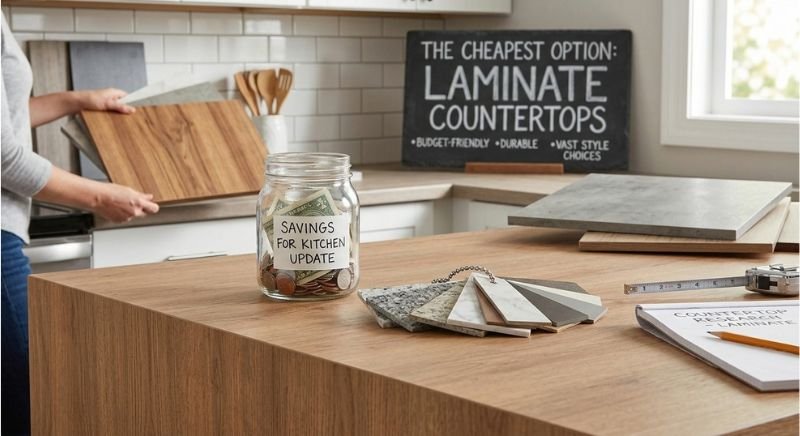
For the lowest upfront material cost, laminate and basic ceramic tile are usually among the strongest contenders. Current U.S. cost sources show ceramic tile material at around $5 to $7 per square foot and laminate commonly starting around $10 per square foot, although actual prices depend on the product.
However, asking only what is the cheapest countertop material misses an important point. The final project includes labor, fabrication, delivery, demolition, cutouts, edging, and sometimes plumbing.
Cheapest Countertop Material for the Lowest Upfront Cost
Basic laminate and ceramic tile can offer very low starting prices. Tile may have a low material cost, but labor can erase part of that advantage because every piece needs to be installed and grouted.
Laminate often wins when you want a straightforward replacement with predictable installation. It is one of the most practical least expensive countertop materials for a typical kitchen.
Cheapest Countertop for DIY Installation
Tile is often attractive for DIY projects because individual pieces can be installed without the specialized fabrication required for a large stone slab. But DIY does not mean effortless.
You need a stable base, accurate measurements, suitable adhesive, proper edge treatment, and careful grout work. Laminate can also work for experienced DIYers, especially with prefabricated sections.
Cheapest Countertop for Long-Term Value
The cheapest long-term choice depends on how you use your kitchen. A low-cost surface that needs early replacement may cost more over time than a moderately priced material that lasts much longer.
Laminate can offer excellent value for light to moderate use. Granite and quartz can provide stronger long-term durability, but their initial investment is much higher.
Countertop Materials by Cost
Comparing countertop materials by cost is easier when you separate material pricing from installed pricing. Current U.S. sources show wide differences between raw material and complete installation costs. Installation can add roughly $10 to $30 per square foot in some estimates, while stone fabrication can make the total considerably higher.
| Countertop Material | Material Cost | Installed Cost | Durability | Maintenance | Best For |
| Laminate | About $10–$40/sq. ft. | Varies by product and layout | Moderate | Low | Lowest-cost replacement |
| Ceramic Tile | About $5–$7/sq. ft. | Higher with labor | Moderate–High | Moderate | DIY projects |
| Porcelain Tile | About $5–$30/sq. ft. | Varies widely | High | Moderate | Durable budget option |
| Butcher Block | Varies by wood | About $30–$100/sq. ft. | Moderate | Moderate | Natural appearance |
| Solid Surface | About $13–$67/sq. ft. | Often higher after fabrication | Moderate | Low | Low-maintenance kitchens |
| Granite | About $40–$60/sq. ft. for common ranges | Often $40+/sq. ft. installed | High | Low–Moderate | Affordable natural stone |
| Quartz | Often $38+/sq. ft. | Often $50+/sq. ft. installed | High | Low | Budget-friendly upgrade |
These figures are planning ranges rather than quotes. For example, HomeAdvisor reports a broad $15 to $70 per square foot average range across countertop projects and notes that installation can add $10 to $30 per square foot.
Cheap Countertops for Durability and Everyday Use
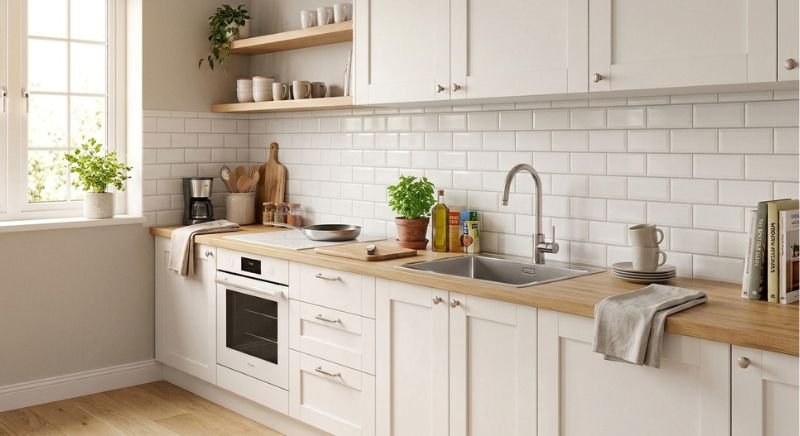
The best cheap countertops are not necessarily the ones with the lowest price. A kitchen sees heat, moisture, knives, food spills, heavy cookware, and constant cleaning. A surface must handle those demands without becoming a daily frustration.
If your kitchen gets light use, laminate can provide excellent value. If you cook heavily and want a natural surface, standard granite may justify the extra cost. Quartz can also offer excellent durability, but it usually requires a larger budget.
Cheapest Countertops for Heavy Kitchen Use
Tile, granite, and quartz can handle demanding kitchen conditions, but they differ in cost and maintenance. Granite offers strong durability at a lower price than many premium stones.
Porcelain tile can also be durable, especially when properly installed. The weak point is often the grout rather than the tile itself.
Cheapest Low-Maintenance Countertops
Laminate and solid surface are attractive choices when easy cleaning matters. Quartz is another low-maintenance option, but it costs more.
If you dislike sealing, detailed grout cleaning, or frequent refinishing, consider maintenance alongside the initial purchase price.
Cheapest Countertops That Last the Longest
Granite and quartz generally sit toward the stronger end of the durability spectrum. Current cost guides rate both as highly durable materials, although their prices vary greatly by grade.
For a homeowner who plans to stay in the home for many years, paying more initially can sometimes provide better value.
Are Quartz Countertops Affordable?
Quartz countertops can be affordable compared with premium natural stone, but they are not usually among the cheapest kitchen countertops. Current 2026 pricing guides place quartz broadly around $50 to $120 per square foot installed, with premium options going higher.
The key is to compare quartz within its own category. A standard quartz color bought as a remnant can be far more affordable than a premium slab with dramatic veining.
When Budget-Friendly Quartz Makes Sense
Budget-friendly quartz makes sense when you want a durable, low-maintenance surface and expect to keep it for many years. It is especially attractive when the rest of your kitchen is already in good condition.
It may not make sense if your main goal is the lowest possible renovation cost. Laminate and tile will usually offer a lower entry price.
How to Find Less Expensive Quartz
Start with remnants and standard colors. Ask fabricators about discontinued patterns, overstock, and smaller leftover pieces.
A simple edge profile can also reduce fabrication costs. Keeping the current layout and avoiding unnecessary sink or cooktop changes can save even more.
Quartz vs. Other Affordable Countertops
Quartz costs more than laminate and many tile options, but it offers a different level of durability and maintenance. Laminate wins on price, while quartz wins when you want a more premium surface with less routine care.
The right choice depends on whether your priority is initial savings or long-term performance.
What Are the Cheapest Stone Countertops?
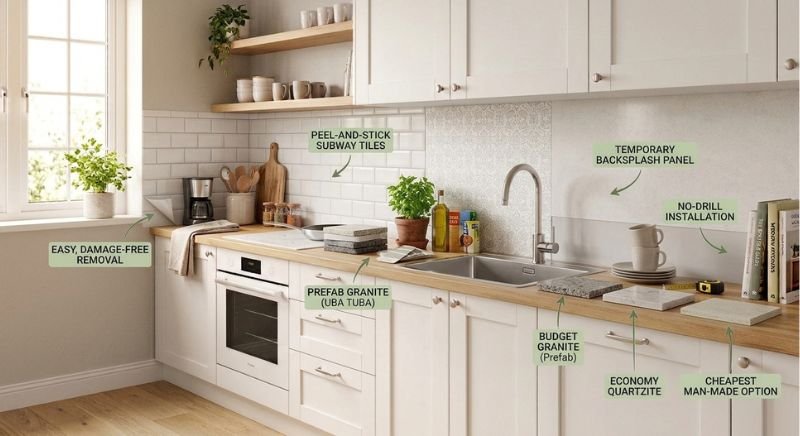
Granite is usually the strongest answer when comparing affordable natural stone options. Standard granite can cost much less than premium marble, quartzite, or exotic stones. Current HomeAdvisor data places granite material around $40 to $60 per square foot for its listed range.
The cheapest stone for countertops is not necessarily the cheapest stone available in every market. Local inventory and fabricator discounts can change the ranking.
Affordable Granite Countertops
Look for common granite colors and lower-tier slabs. Unusual patterns and premium colors can carry much higher prices.
Granite offers strong durability and a natural appearance, making it one of the better affordable stone countertops when you want genuine stone without moving into luxury materials.
Granite Remnants
Granite remnants can dramatically reduce the amount of stone you need to purchase. They work especially well for small kitchens, islands, bathroom vanities, and smaller counter sections.
Your design must fit the remnant. That means you may have less freedom over color and pattern than with a full slab.
Prefabricated Stone Countertops
Prefabricated stone pieces can reduce fabrication costs because they are produced in standard dimensions. They can work well when your kitchen has a straightforward layout.
Always confirm measurements before purchasing. A low-priced piece is not a bargain if it cannot accommodate your cabinets or required cutouts.
How to Save Money on Stone Countertops
Choose standard colors, compare multiple fabrication quotes, and ask about remnants. Keep the edge profile simple and avoid unnecessary seams or complex shapes.
Also compare the complete quote rather than the slab price alone. Fabrication, sink cutouts, delivery, installation, demolition, and plumbing can all affect the final number.
How Much Do Cheap Countertops Cost?
Cheap countertops can range from a few hundred dollars for a small DIY-friendly project to several thousand dollars for a professionally installed kitchen. Current HomeAdvisor data puts average kitchen countertop replacement around $1,852 to $4,463, with an average near $3,144.
Your kitchen size matters, but it is not the only factor. A small kitchen with several corners and custom cutouts can cost more per square foot than a larger, simple kitchen.
Countertop Material Cost vs. Installation Cost
Material cost covers the surface itself. Installation cost can include measuring, fabrication, cutting, edging, transportation, removal, and fitting.
For example, a tile may have a very low material price but require considerable labor. A laminate top may cost more as a complete product but take less time to install.
What Makes Countertop Installation More Expensive?
Complex layouts increase labor. Sink and cooktop cutouts, unusual corners, thick edges, backsplashes, seams, demolition, and plumbing changes can all raise the bill.
Stone also requires specialized fabrication. HomeAdvisor notes that sink work and cabinet-related preparation can add to granite project costs.
DIY vs. Professional Countertop Installation
DIY can reduce labor costs, but it is not suitable for every material. Tile and some laminate projects are more approachable for experienced homeowners.
Large stone slabs are different. They are heavy, difficult to transport, and require precise cutting. Mistakes can be expensive, so professional installation often makes more sense.
Cheap Kitchen Countertop Ideas to Reduce Your Total Cost
The smartest budget strategy is not always choosing the cheapest material. Sometimes changing the project itself saves more money than changing the countertop.
For example, keeping your current layout avoids unnecessary cabinet changes, plumbing changes, and new cutouts.
Keep the Existing Countertop Layout
Leave sinks, appliances, corners, and cabinet positions where they are whenever possible. This reduces fabrication changes and prevents extra work.
A simple replacement can become expensive when the new countertop requires a completely different configuration.
Choose Remnant or Prefabricated Materials
Remnants work well for smaller areas, while prefabricated pieces can reduce fabrication costs for standard layouts.
Ask fabricators what they have available before choosing a specific material. The inventory may surprise you.
Choose a Simple Edge Profile
Fancy edges require additional fabrication. A simple eased or standard edge can provide a clean appearance while keeping costs controlled.
The edge is one of those details that can quietly increase the final bill.
Compare Material and Installation Quotes
Do not compare only the material price. Ask each supplier what the quote includes.
Check whether removal, disposal, delivery, cutouts, edging, installation, and plumbing work are included.
Consider DIY Installation Where Appropriate
DIY can make affordable DIY countertops even more affordable, but only when you have the tools and skills needed.
Never choose DIY simply because the labor seems expensive. A damaged countertop can cost more to replace than professional installation would have cost initially.
Shop Clearance and Overstock Materials
Clearance and overstock materials can provide excellent savings. This works especially well if you are flexible about color or pattern.
Ask whether the material is discontinued and whether enough stock exists for future repairs.
Avoid Unnecessary Sink and Plumbing Changes
Moving a sink can turn a simple countertop replacement into a larger remodeling project. Keeping the existing sink location can reduce both plumbing and fabrication costs.
The same principle applies to cooktops and other built-in fixtures.
Choose Standard Colors and Sizes
Standard products usually have wider availability and simpler fabrication. Custom colors, unusual slab patterns, and special sizes can increase costs.
If price is your main goal, simple choices often work in your favor.
How to Choose the Best Cheap Countertop for Your Kitchen
The best affordable countertop depends on more than price. Think about how you cook, how long you plan to stay in the home, how much maintenance you can handle, and what appearance you want.
A cheap countertop that fits your lifestyle will usually feel like a better purchase than an expensive surface chosen only for its looks.
Set Your Total Countertop Budget
Start with the amount you can actually spend on the complete project. Leave room for installation, removal, cutouts, delivery, and unexpected repairs.
A material budget alone can create an unrealistic picture.
Compare Installed Cost, Not Just Material Price
Always compare the final installed price. Two materials with similar material costs can have very different fabrication and installation expenses.
This is one of the most important rules when comparing countertop options and cost.
Consider Durability and Expected Lifespan
Think about how much abuse the countertop will receive. A family kitchen used several times each day needs a different surface from a rarely used kitchenette.
A slightly higher initial cost may make sense if it prevents early replacement.
Consider Maintenance Requirements
Some surfaces need sealing, refinishing, or regular grout care. Others mainly need normal cleaning.
Choose a countertop that matches the amount of maintenance you are willing to perform.
Think About Your Kitchen’s Daily Use
If you frequently cook, bake, chop, and place hot cookware on the counter, durability matters more.
If you mainly prepare simple meals, you may not need to spend heavily on a premium surface.
Match the Countertop to Your Kitchen Style
Laminate can imitate stone and wood. Tile can add pattern. Butcher block adds warmth. Granite brings natural variation, while quartz provides a controlled and polished appearance.
A budget surface does not have to look like a budget surface.
Factor in Installation and Fabrication Costs
This final step can prevent the biggest budget surprises. Ask for a complete written quote that explains fabrication, installation, cutouts, removal, delivery, and any additional work.
Cheapest Countertops by Your Priority
| Priority | Best Budget Option |
| Lowest upfront cost | Laminate |
| Best DIY option | Tile |
| Natural appearance | Butcher block |
| Low maintenance | Laminate / Solid surface |
| Affordable stone | Granite remnants |
| Premium look on a budget | Remnant quartz or granite |
| Long-term durability | Granite / Quartz |
| Cheapest makeover | Refinish existing countertop |
Laminate leads for low upfront cost because it combines accessible material pricing with relatively straightforward installation. Current estimates continue to place laminate among the lowest-cost mainstream countertop materials.
Tile stands out for DIY work because individual pieces can be installed without ordering a large custom slab. But the finished surface needs careful grout work.
Butcher block wins when warmth and natural character matter. Granite remnants offer genuine stone at a lower price when the available piece fits your design.
Quartz or granite remnants can also create a premium appearance without requiring a full slab purchase. For the cheapest makeover, refinishing an existing countertop can beat nearly every replacement option.
Cheap vs. Expensive Countertops: What Do You Get for Your Money?
The price gap between budget and premium countertops usually reflects more than appearance. You may be paying for material strength, fabrication, customization, heat resistance, longevity, or a more specialized installation.
| Factor | Cheap Countertops | Expensive Countertops |
| Upfront cost | Lower | Higher |
| Installation cost | Often simpler | Often more specialized |
| Durability | Varies | Usually higher |
| Maintenance | Varies | Often lower for quartz |
| Appearance | Many modern choices | More natural or premium finishes |
| Customization | Moderate | High |
| Repairability | Depends on material | Depends on material |
| Expected lifespan | Moderate to long | Often long |
| Long-term value | Strong when chosen carefully | Strong when used for many years |
The goal is not to avoid spending money. The goal is to spend it where it improves the kitchen.
When Paying More for a Countertop Makes Sense
Paying more makes sense when you plan to keep the kitchen for many years, cook heavily, or want a surface that will handle demanding daily use.
Granite and quartz can justify their higher initial prices when durability and long-term performance matter. However, a premium material is not automatically better for every homeowner.
When a Cheap Countertop Is the Better Choice
A cheap countertop can be the smarter choice when the kitchen is temporary, the home may be sold soon, the remodel has a tight budget, or the existing cabinets do not justify a major investment.
There is also no reason to spend thousands on a premium slab when a well-chosen laminate surface solves the problem just as effectively.
FAQs
What Is the Cheapest Countertop to Install?
Laminate and basic tile are usually among the most affordable options. Ceramic tile can have a very low material cost, while laminate often offers a simpler overall replacement. Actual installation costs depend on the kitchen layout and labor.
What Is the Cheapest and Most Durable Countertop?
There is no single winner for every kitchen. Laminate offers strong value at a low price, while granite can provide greater durability at a higher cost. Porcelain tile is another budget-friendly option when installed correctly.
Are Cheap Countertops Worth It?
Yes, when the material matches your kitchen use. A low-cost countertop can be an excellent choice if you prioritize function, keep the existing layout, and choose a product suited to your daily habits.
What Is the Cheapest Stone for Countertops?
Standard granite is often one of the most affordable natural stone options. Granite remnants can lower the price further because you pay for a smaller piece rather than an entire slab. Current granite material pricing varies by grade and location.
Are Quartz Countertops Affordable?
Quartz can be affordable compared with premium stone, but it is generally not one of the cheapest countertop materials. Remnants, standard colors, and lower-priced product lines can make quartz more accessible.
What Is the Most Affordable Kitchen Countertop?
For many homeowners, laminate is the most affordable mainstream kitchen countertop. Tile can also be extremely inexpensive as a material, especially for DIY projects.
Can You Replace Kitchen Countertops Without Replacing Cabinets?
Yes. Countertops can often be replaced while keeping existing cabinets if the cabinets are structurally sound and the new countertop fits the cabinet layout.
Keeping the cabinets and layout can save a substantial amount compared with a full kitchen remodel.
How Can I Make My Countertops Cheaper?
Keep the existing layout, choose standard colors, compare multiple quotes, use remnants, consider prefabricated pieces, select simple edges, and avoid unnecessary plumbing changes. Refinishing a sound existing countertop can reduce costs even further.
Final Thoughts on the Cheapest Countertops
The cheapest countertop is not always the one with the lowest price per square foot. The real bargain is the surface that fits your budget, handles your kitchen routine, and does not create expensive problems during installation.
Laminate remains one of the strongest choices for low-cost replacement. Tile can work well for DIY projects, while butcher block adds natural warmth. Granite remnants can bring real stone into a tighter budget, and affordable quartz can make sense when long-term durability and low maintenance matter more than the lowest upfront price.
Before buying, compare the complete project cost. Look at material, fabrication, installation, removal, cutouts, delivery, and maintenance. That simple comparison can turn a cheap countertop into a genuinely smart kitchen investment.