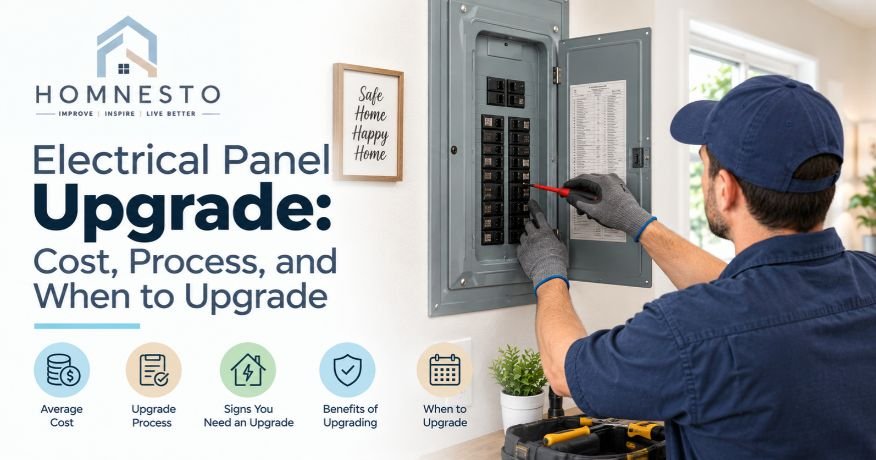

Wondering whether your home needs an electrical panel upgrade and what it may cost? The answer depends on more than the breaker box itself. Replacing an existing panel at the same rating is different from increasing electrical service from 100 amps to 200 amps, while adding a subpanel is a separate option that does not automatically provide more total power. Each project has a different scope, cost, and approval process.
What Is an Electrical Panel Upgrade?
An electrical panel also called a breaker box or load center distributes incoming electricity to circuits powering lights, outlets, and appliances. An upgrade can mean replacing old or unsuitable equipment, adding capacity for new circuits, or increasing the service available to the property. The right option depends on panel condition, calculated electrical demand, and the work proposed. A home electrical panel upgrade does not automatically increase the power supplied to the home.
Electrical Panel Upgrade vs. Electrical Panel Replacement
A panel replacement generally means removing an existing panel and installing a new one, sometimes at the same service rating. For example, a damaged 100-amp panel may be replaced with a suitable 100-amp panel if capacity remains adequate. An electrical panel replacement cost estimate should state whether the work is like-for-like or includes a capacity change. A new panel may add suitable circuit spaces, but it does not itself increase the capacity of incoming service conductors.
You may also encounter the phrases electric panel upgrade, updating electrical panel, residential electrical panel upgrade, and electrical box upgrade. They are often used informally, so confirm whether the contractor means a same-capacity replacement, added circuit spaces, or an electrical service upgrade.
Electrical Panel Upgrade vs. Electrical Service Upgrade
An electrical service upgrade increases or changes the capacity of the supply serving the home. It may involve the panel, service entrance conductors, meter equipment, disconnects, grounding and bonding, and utility coordination. A panel-only replacement may be sufficient when existing service capacity is appropriate. If you are adding an EV charger, electric heating, or other large loads, ask an electrician whether the service itself must change.
Main Electrical Panel vs. Subpanel
The main panel is the primary distribution point for household circuits. A subpanel is a secondary panel supplied by a feeder from the main panel, often used to organize circuits in a garage, addition, or workshop. It can add circuit spaces, but it does not automatically increase total available power. The cost of sub panel installation may be lower than a full service upgrade in some cases, but a professional must verify that the service and feeder can support the combined load.
Signs You May Need an Electrical Panel Upgrade
A warning sign is a reason to investigate, not proof that the entire panel needs replacement. A qualified electrician should assess equipment condition, circuit behavior, calculated load, and alternatives before recommending a project. If you notice smoke, active sparking, or a strong burning smell at the panel, keep away and seek emergency assistance as appropriate.
Circuit Breakers That Trip Frequently
Repeated trips can result from an overloaded circuit, faulty appliance, short circuit, damaged wiring, or a defective breaker. They do not automatically mean the panel is too small. Avoid repeatedly resetting a breaker; note what was running and arrange professional assessment if the problem repeats. For more context, understand why does a circuit breaker keep tripping. So you know why diagnosis should come before assuming an upgrade is needed.
An Electrical Panel With No Suitable Space for Additional Circuits
A panel with no suitable breaker spaces may complicate adding a circuit for a new appliance or renovation. The answer is not necessarily a full service upgrade: depending on the panel, circuit design, and available capacity, a suitable replacement or subpanel may work. Never use improvised double-tapping or unsuitable breakers to create space. Have the electrician check both physical spaces and electrical load.
An Outdated, Damaged, or Potentially Unsafe Electrical Panel
Corrosion, scorching, water intrusion, damaged components, unusual heat, or unreliable protective devices warrant professional assessment. Some older panels may raise design or condition concerns, but age alone does not prove a panel is defective. Do not remove the cover or touch internal parts. For smoke, active sparking, or a strong burning smell, stay away and contact emergency services when appropriate.
Adding Major Appliances, an EV Charger, or a Heat Pump
An EV charger, heat pump, electric range, hot tub, or other large load may require a dedicated circuit and an assessment of service capacity. The equipment rating, how it will be used, and existing household loads matter. Before buying equipment, ask an electrician to perform the appropriate load calculation and identify circuit, panel, or service changes. Some homes can accommodate a new load without replacing the main panel; others may need load management, a subpanel, or service upgrade.
Planning a Home Renovation or Solar Installation
A kitchen remodel, basement conversion, addition, or solar installation can introduce new circuits or interconnection requirements. Planning early helps identify constraints before walls are closed or equipment is ordered. A panel upgrade for solar may be needed if existing equipment cannot accommodate the proposed design, but not every solar installation requires a replacement. Ask the electrician, solar contractor, and utility what applies to your property.
Electrical Panel Upgrade vs. Repair: Which Do You Need?
The choice depends on safety, equipment condition, circuit space, service capacity, planned loads, and the cost of appropriate repairs. Electrical panel upgrade or repair is a decision that should follow diagnosis not the panel’s age alone.
When an Electrical Panel Repair May Be Enough
Repair may be suitable when an electrician identifies a specific, repairable fault and the remaining equipment is in acceptable condition. A defective breaker or localized connection issue may not require full replacement, depending on the diagnosis and applicable requirements. Never replace breakers or tighten internal connections yourself. If the panel shows broad damage, overheating, or unsuitable components, ask whether repair remains a sound solution.
When Replacing the Existing Panel Makes More Sense
Replacement may make sense when the panel is damaged, cannot safely accommodate needed circuits, contains unsuitable equipment, or has limitations that make reliable repairs impractical. The new panel must be compatible with the service and the home’s requirements. Replacement can retain the same service capacity if a larger service is unnecessary. Ask the estimate to identify the panel rating, breaker compatibility, circuit work, permits, and additional repairs.
When Increasing Electrical Service Capacity Is Necessary
A service upgrade may be appropriate when a load calculation shows the current service cannot safely support existing or planned demand, or when incoming equipment is unsuitable for the required capacity. It may involve meter equipment, conductors, grounding and bonding, and utility work in addition to the panel. Ask the electrician to explain the calculation and whether approved load-management alternatives are suitable.
Is an Electrical Panel Upgrade Worth the Cost?
Electrical panel upgrades worth considering are those that address a verified safety concern, provide necessary capacity, or make a planned renovation feasible. They are not automatically worthwhile because a home is older or a larger panel is available. Compare repair, same-capacity replacement, a subpanel, load management, and a full service upgrade. A clear written diagnosis helps avoid paying for work that does not solve the problem.
Electrical Panel Upgrade Cost: What Affects the Price?
Angi’s 2026 US cost guide reports that many professional panel upgrades fall around 1,200–2,000, while more involved projects can cost more. Estimates vary because “upgrade” may mean a panel-only change or a wider service project. The cost to upgrade electrical panel depends on current equipment, service rating, access, local labor rates, permits, and whether the incoming service must change.
Online searches may phrase the question as electric panel upgrade cost, cost to update electrical panel, or how much to replace electrical panel. These phrases can describe different scopes, so compare the panel rating, service work, permits, and included materials before comparing prices.
Average Cost to Upgrade or Replace an Electrical Panel
Angi’s 2026 guide lists many professional upgrades at approximately 1,200–2,000, while its broader upgrade guidance gives a range of roughly 1,000–4,500 depending on scope. Treat these as US planning figures, not a quote. The cost of new electrical panel equipment is only one part of the total; labor, permits, testing, and any additional work can change the final amount.
Electrical Panel Replacement Cost vs. Full Service Upgrade Cost
A same-capacity replacement is generally simpler than increasing service capacity. A full electrical service upgrade may require larger conductors, a new meter socket, a service mast or entrance, utility scheduling, and additional inspections. Ask whether the electrical panel replacement cost estimate is for the panel alone or the complete service project. The electrical service upgrade cost should list included components and any utility work excluded from the contractor’s scope.
Labor, Materials, Permits, and Inspection Costs
A written estimate may include the panel and breakers, labor, permit fees, inspection coordination, disposal, labeling, and testing. Permit and inspection requirements vary by locality. Ask whether the electrical panel installation cost includes grounding and bonding corrections, new breakers, patching or painting, and follow-up visits. Compare itemized scopes rather than headline totals.
When Wiring, Meter, or Service Entrance Work Adds to the Cost
Costs can rise if conductors are unsuitable, the meter socket needs replacement, the service mast is damaged, the panel must move, or existing wiring needs correction. Water damage and inaccessible equipment can also add work. The cost to replace electrical panel and wiring may be substantially higher than a panel-only replacement if significant rewiring is necessary. Ask the electrician to separate required safety work from optional improvements.
How to Compare Electrical Panel Upgrade Estimates
Get written estimates from qualified electricians and compare the same scope. Each quote should identify the panel and service rating, circuit work, permit responsibilities, utility coordination, grounding or bonding work, testing, cleanup, warranty, and exclusions. Ask what could change the price and how additional work will be approved. The lowest quote may not be the best value if important work is omitted.
How Much Does It Cost to Upgrade to a 200-Amp Electrical Panel?
A 200-amp service is common in many US homes, but it is not automatically necessary or sufficient for every property. The cost to upgrade electrical panel to 200 amps depends on whether the existing meter and service entrance can support the new rating. A qualified electrician must calculate the load and identify what equipment needs changing before recommending a project.
Cost to Upgrade from 100 Amp to 200 Amp
A 100 amp to 200 amp upgrade cost can be relatively modest when the site is straightforward, but it may rise if service conductors, meter equipment, the mast, utility connection, or grounding and bonding require work. The cost to upgrade electrical panel from 100 to 200 amps should not be based on panel price alone. Ask each contractor to state exactly what is included.
Searches such as how much to upgrade electrical panel to 200 amp and cost to replace 200 amp panel are best answered after an electrician checks the existing service path. A quote for the panel alone may differ sharply from a complete service upgrade.
What Affects the Cost of a 200-Amp Service Upgrade?
The 200 amp service upgrade cost depends on panel location, access, labor rates, service conductors, meter equipment, overhead or underground service, permits, utility scheduling, and required repairs. When comparing the cost to upgrade to 200 amp service, check whether the quote includes the new panel, meter equipment, conductors, grounding and bonding updates, permits, inspections, and utility work.
Is 200-Amp Service Enough for Your Home?
It may be enough for many homes, but the answer depends on calculated load, major appliances, heating and cooling, EV charging, and future plans. Larger homes or properties with several high-demand electric systems may need a different approach. Ask the electrician to explain expected demand and options; do not choose service capacity using a generic rule.
Will a 200-Amp Upgrade Require New Wiring or Other Equipment?
Not every project requires replacing all branch-circuit wiring, but service conductors and related equipment must be suitable for the new rating. Work may include a meter socket, service entrance, disconnect, grounding and bonding, or selected circuits. Ask whether the 200 amp panel upgrade cost or panel upgrade 200 amp cost includes those items. A 200 amp electrical panel cost for hardware alone is not comparable with a complete installed service upgrade.
Related Electrical Guides
Homnesto’s live electrical category currently lists two related articles. They offer useful context for understanding the system and diagnosing symptoms before deciding that an upgrade is necessary.
For a broader overview, read home electrical guide, which covers panels, circuits, appliance loads, and when to call a professional.
What Is the Electrical Panel Upgrade Process?
The electrical panel upgrade process starts with an assessment and scope definition, then moves through equipment selection, permits and utility coordination, installation, and required testing or inspection. The sequence varies by locality. Panel and service work should be handled by a properly qualified professional.
Step 1: Assess the Existing Panel and Electrical Load
The electrician reviews the existing panel, service rating, visible condition, circuit spaces, and household demand. They may ask about planned appliances, EV charging, renovations, solar equipment, and recurring problems. This helps distinguish a panel replacement from a service upgrade or another option. Ask what supports the recommendation and whether more investigation is needed before the quote is final.
Step 2: Select the Appropriate Panel and Service Capacity
The electrician recommends equipment that fits the calculated load, required circuits, location, and applicable rules. If the project changes service capacity, confirm that utility-side equipment and service conductors can support it. A subpanel can help with circuit organization, but does not by itself increase total service capacity.
People often search how to upgrade electrical panel or how to update electrical panel when planning this work. Because the task can expose dangerous energized components and may require permits and utility coordination, these steps should be completed by a qualified professional rather than followed as a DIY project.
Step 3: Arrange Permits and Utility Coordination
Depending on the jurisdiction and scope, the contractor may need an electrical permit, utility approval, planned disconnection, and a scheduled inspection. Confirm requirements with the local authority and serving utility before work begins. Ask who submits applications, schedules utility work, pays fees, and arranges final inspection.
Step 4: Complete the Panel Installation or Service Upgrade
The electrician coordinates the power interruption, removes or modifies equipment, installs the new panel or service components, and reconnects circuits according to the approved scope. The amount of disruption depends on the project. Do not open the panel or attempt to keep circuits energized during installation. Ask how to prepare appliances and essential equipment before work starts.
Step 5: Complete Required Testing and Inspections
After installation, the electrician performs relevant checks and arranges required inspection or approval. Tests and sign-off depend on the work and local rules. Keep permit records, inspection results, warranty information, and the final invoice, and clarify whether any follow-up work remains.
How Long Does an Electrical Panel Upgrade Take?
Installation time and total project time differ. A straightforward replacement may be completed in a working day, while a service upgrade can take longer because permits, utility scheduling, equipment availability, and unexpected repairs affect the timeline. Ask the contractor for a property-specific estimate.
How Long Does Electrical Panel Replacement Take?
A simple replacement may take several hours to a full workday, depending on circuits, access, equipment, and the condition of the installation. More extensive service work can extend the job. How long does it take to replace an electrical panel therefore depends on the actual scope. Confirm when power will be disconnected and restored.
Will the Power Be Turned Off During the Upgrade?
Power to the affected service or circuits usually must be shut off while the electrician works. The length of the outage depends on the project and utility coordination. If anyone relies on powered medical equipment or has another essential need, discuss a safe contingency before the work date. Do not attempt temporary connections or bypass the outage.
What Can Delay the Installation or Final Approval?
Delays may result from permits, utility appointments, equipment availability, access problems, damaged existing components, or additional work discovered during installation. Ask for a realistic schedule and a plan for communicating changes, especially when utility or inspector availability affects the completion date.
Special Electrical Panel Upgrade Situations
Some projects have additional design or safety considerations. The right solution depends on the specific equipment, service, utility requirements, and planned loads; a general article cannot determine the correct design for an individual home.
Electrical Panel Upgrades for Solar Panels and EV Chargers
Solar equipment and EV chargers can introduce new load and interconnection requirements. An electrical panel upgrade for solar may be needed if existing equipment cannot accommodate the proposed design, but not every solar installation requires replacement. Ask the electrician, solar or EV contractor, and utility to evaluate service capacity, circuit space, equipment ratings, and local requirements.
Replacing a Federal Pacific Electrical Panel
Federal Pacific Electric (FPE) Stab-Lok panels are a concern in some older homes and should be assessed by a qualified electrician familiar with the equipment. The US Consumer Product Safety Commission closed its investigation in 1983 without determining that the breakers posed a serious risk, and the agency did not make a definitive safety determination. Avoid assuming every installation has the same condition. Ask for a written professional assessment; the cost to replace federal pacific panel depends on whether service, meter, wiring, or other work is also needed.
When a Subpanel May Be an Alternative
A subpanel may help when more circuit spaces are needed for a garage, addition, or workshop, provided the existing service and feeder can support the added load. It is not a shortcut around an undersized service. Ask for an assessment and an itemized estimate covering the feeder, location, circuit work, permits, and inspection. Compare this with a main-panel replacement or service upgrade.
How to Choose an Electrician for an Electrical Panel Upgrade
Choose a professional who can explain the diagnosis, define the work, and document the project. An electrician for panel upgrade work should have the qualifications required locally, appropriate insurance, residential experience, and a clear written estimate.
Verify Licensing, Insurance, and Local Qualifications
Check credentials with the relevant state or local authority and ask about insurance and experience with similar projects. Requirements vary by location. Confirm who will perform the work, who obtains permits, and whether utility contractors or subcontractors are involved.
Request an Itemized Written Estimate
The estimate should identify the proposed panel and service rating, labor, materials, permits, utility coordination, grounding and bonding, circuit changes, testing, cleanup, and exclusions. If quotes differ, compare scope line by line rather than assuming the lower price covers the same work.
Ask Who Handles Permits, Utility Coordination, and Inspections
Confirm who obtains permits, contacts the utility, schedules disconnection and reconnection, and arranges required inspections. Responsibilities vary. Ask how inspection findings will be addressed and whether a return visit is included, and keep copies of permits and completion records.
Confirm Warranties and What the Quote Excludes
Ask about manufacturer warranties, workmanship coverage, and the process for requesting service if a problem appears. Clarify whether patching, painting, concealed wiring repairs, utility charges, and follow-up visits are included. Get significant changes to the scope and price in writing.
FAQs About Electrical Panel Upgrades
Can I Upgrade My Electrical Panel Without Replacing All the Wiring?
Sometimes. Replacing a panel does not automatically require replacing all branch-circuit wiring, but an electrician must assess condition, compatibility, grounding, and local requirements. Damaged or unsuitable wiring may need repair or replacement.
Does an Electrical Panel Upgrade Require a Permit?
Many panel replacements and service upgrades require a permit and inspection, but rules vary by location and scope. Confirm requirements with the local authority and ask the contractor who will obtain the permit.
Can I Upgrade an Electrical Panel Myself?
Panel and service work is hazardous and may be restricted by local law or permit rules. Hire a properly qualified electrician. Do not open the panel, handle conductors, or attempt a DIY replacement.
Will a Panel Upgrade Increase My Home’s Electrical Capacity?
Not necessarily. Replacing a panel at the same service rating may improve equipment condition or circuit space without increasing total power available. Increasing capacity generally requires assessing service equipment and the incoming supply.
Does Installing Solar Panels Always Require a Panel Upgrade?
No. The need depends on existing equipment, system design, electrical load, interconnection requirements, and utility rules. Have the solar contractor and a qualified electrician assess the property before finalizing the design.
Sources for Cost and Safety Information
The cost ranges in this article use current 2026 US consumer cost guidance from Angi. The guides report that many panel upgrades fall around 1,200–2,000, while broader service projects can cost more. Actual prices depend on location and scope, so homeowners should obtain written local estimates.