
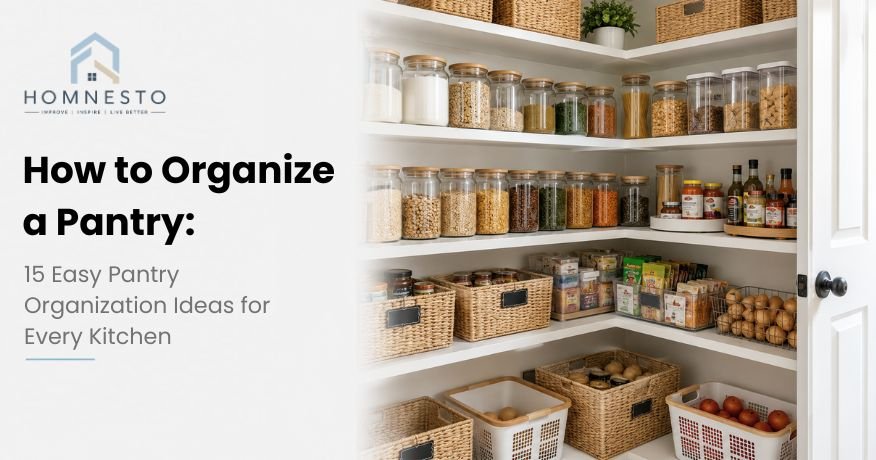

A cluttered pantry can make everyday cooking feel harder than it needs to be. When cans are stacked behind boxes, snacks spill across shelves, and frequently used ingredients are difficult to reach, you waste time searching and may even buy food you already have. Learning how to organize pantry space can solve these problems by giving each category a clear place and making better use of the storage space you already have.
For more ways to make the whole kitchen easier to use, explore these kitchen organization ideas.
An effective pantry does not require expensive organizers or a large kitchen. Simple pantry storage solutions, such as clear containers, baskets, shelf risers, labels, and a lazy susan, can improve visibility and access when used for the right purpose. The key is to avoid common mistakes such as overcrowding shelves, mixing unrelated food categories, buying containers before measuring, or storing everyday items in difficult-to-reach areas.
In this guide, you will learn practical pantry organization ideas for small pantries, pantry cabinets, closets, and walk-in spaces. You will also learn how to arrange pantry shelves, organize food by category, choose suitable storage containers, and create a system that remains easy to maintain long after the initial cleanup.
Quick Pantry Organization Checklist
| Pantry area | Organization method | Recommended storage solution |
| Everyday foods | Keep at eye level | Open bins or clear containers |
| Canned goods | Group by type and size | Shelf risers or can organizers |
| Dry goods | Transfer frequently used foods | Airtight containers |
| Snacks | Create one dedicated zone | Baskets or clear bins |
| Baking supplies | Store together | Matching containers or bins |
| Spices | Arrange by frequency of use | Spice riser or organizer |
| Small packets | Keep upright and contained | Small bins or drawer organizers |
| Deep corners | Make items easy to rotate | Lazy susan |
| Heavy items | Store low | Sturdy baskets or lower shelves |
| Bulk supplies | Keep together | Large labeled bins |
| Seasonal items | Move out of prime space | Upper shelves |
| Pantry door | Use for lightweight items | Door racks or narrow bins |
The table is a starting point rather than a strict rule. Your best layout depends on the pantry’s dimensions and what your household uses most often.
What You Need Before Organizing Your Pantry
You do not need to purchase every organizational product available before you begin. Buying containers and organizers too early can actually make pantry organization more difficult because you may end up with products that do not fit your shelves or match the amount of food you store. Start by assessing what you already have, then buy only the tools that solve a clear storage problem.
A practical pantry should do more than look tidy. It should make everyday cooking, grocery shopping, and restocking easier. The best kitchen storage solutions are the ones that improve visibility and access without creating extra work. Once you empty and sort the pantry, you will have a much clearer idea of which storage products are genuinely useful.
Before purchasing anything, consider your shelf dimensions, the types of food you normally buy, and how often you use each category. This helps you choose pantry storage solutions that fit your actual routine instead of creating a system that looks good but is difficult to maintain.
Storage Containers
Storage containers are especially useful for dry goods such as rice, flour, pasta, cereal, oats, beans, grains, and other pantry staples. They can keep loose foods contained, make shelves easier to clean, and allow you to see how much of a frequently used ingredient remains.
Airtight containers can be helpful for suitable dry foods because they can protect contents from moisture and keep food contained. However, not every pantry item needs to be transferred from its original packaging. If the original package is already practical, protective, and easy to store, leaving the food in it may be the better choice.
Choose container sizes according to the amount of food you normally purchase and the dimensions of your pantry shelves. A container that is too large can waste valuable shelf space, while one that is too small may require frequent refilling. Measuring your shelves before buying containers can prevent unnecessary purchases.
Labels and Label Makers
Labels make a pantry organization system easier to understand and maintain. They are particularly useful when you use opaque containers, store several similar-looking ingredients, or have multiple people putting groceries away.
You can use a label maker, adhesive labels, chalk labels, or simple handwritten labels. The method matters less than making the contents easy to identify. A clear label can also help prevent confusion when ingredients such as flour, sugar, rice, or similar dry goods are stored in matching containers.
Keep labels short and easy to read. Words such as “Pasta,” “Baking,” “Snacks,” or “Rice” are usually sufficient. If a container may hold different foods in the future, use removable labels so you can update the contents without replacing the container.
Baskets and Storage Bins
Baskets and storage bins work particularly well for small packages and awkwardly shaped foods that are difficult to stack. Snack packets, drink mixes, lunchbox items, and small bags can quickly spread across a shelf when they do not have a defined storage area.
Placing related items in one basket creates a simple zone without requiring every package to be perfectly aligned. It also makes cleanup easier because several items can be returned to their designated area at once.
Choose baskets and bins according to the depth and height of your shelves. Avoid very deep containers for small products if the contents will become difficult to see. A storage bin should improve access and visibility rather than simply hide clutter.
Shelf Risers and Organizers
Shelf risers create an additional level within the vertical space of a pantry shelf. They are particularly useful for canned goods, jars, spice containers, and other short products that can easily disappear behind taller items.
Without a riser, the back row of cans may be hidden from view, causing you to forget what you already have. A properly sized riser allows you to see more products at once and can make it easier to choose what you need without moving several items.
Measure your shelves before purchasing a riser or other pantry organizer. Make sure there is enough clearance to remove products comfortably. An organizer that takes up too much space or makes shelves difficult to access can create more problems than it solves.
Cleaning Supplies
Cleaning supplies should be ready before you begin restocking. A vacuum or handheld brush can remove crumbs from corners, while a microfiber cloth can wipe shelves clean. Use a cleaner that is appropriate for the material of your pantry shelves.
Pay close attention to areas around flour, cereal, sugar, grains, and other dry foods. Small particles can collect along shelf edges and corners even when the pantry looks generally clean. Cleaning these areas before returning food gives you a fresh starting point.
Allow shelves and surfaces to dry completely before putting food back. This simple step helps prevent moisture from being trapped underneath containers and packages and gives you a cleaner foundation for your new pantry layout.
How to Organize a Pantry
The most effective approach to organizing a pantry is to start with an empty space and create a layout based on how you actually use it. Trying to rearrange individual cans and boxes while everything remains inside often leaves the underlying problems unresolved.
A practical process is to assess the space, remove everything, sort products into categories, check food dates and packaging, clean the shelves, and then plan where each category should go. Following this order gives you a better understanding of how much food you have and which areas need improvement.
The goal is not to make every shelf look identical. A well-organized pantry should make everyday tasks easier. You should be able to find common foods quickly, put groceries away without thinking too much about where they belong, and access products without having to move half the shelf.
Assess Your Pantry Space
Look carefully at the pantry before deciding what storage products you need. Measure the width, depth, and height of the shelves if you are planning to purchase containers, shelf risers, bins, or other organizers.
Pay attention to problem areas such as deep corners, unusually tall shelves, narrow sections, and the inside of the pantry door. These areas often determine which pantry shelving ideas will actually work. A deep shelf may need a turntable or pull-out basket, while a tall shelf may benefit from a riser.
Your household’s habits should also influence the layout. If certain foods are used every day, they should be easier to reach than specialty ingredients. If children regularly access snacks, appropriate items can be placed at a safe and convenient height.
Empty Everything First
Take everything out of the pantry before you begin reorganizing. Although this can make the space look more cluttered temporarily, it gives you a complete view of what you own and how much space your food actually requires.
Place products on a clean counter, table, or other suitable surface as you remove them. You will often discover duplicate purchases, forgotten ingredients, damaged packages, or products that no longer need to occupy valuable pantry space.
Emptying the pantry also makes cleaning much easier. You can reach every corner and shelf instead of trying to clean around boxes and containers. More importantly, you can create your layout based on the actual contents rather than trying to fit new organize pantry ideas around an already crowded arrangement.
Sort Items Into Categories
Create practical pantry categories based on the foods you regularly purchase and use. Common categories include breakfast foods, snacks, baking supplies, canned goods, dry goods, pasta, sauces, spices, beverages, and cooking staples.
Keep categories broad enough to remain manageable. You do not need a separate zone for every type of food if you only have a few products in each group. Combining related products can make the pantry easier to maintain.
The purpose of categories is to make food easier to find and return. When everyone in the household understands that snacks belong in one basket or baking ingredients belong on a particular shelf, maintaining an organized pantry becomes much less difficult.
Remove Expired Food
Check dates and packaging as you sort. Follow the manufacturer’s storage instructions and pay attention to the condition of the packaging rather than relying on dates alone for every type of shelf-stable food.
Remove anything that is damaged, leaking, contaminated, infested, or otherwise unsuitable for use. You can also set aside foods that your household is unlikely to use so they do not continue taking up valuable storage space.
Do not put everything back and plan to check it later. Removing unsuitable items during the initial sorting process creates more usable space and makes it easier to see which foods you actually need to organize.
Clean Pantry Shelves Before Restocking
Once everything is out, clean the pantry shelves before returning any food. Vacuum or brush away crumbs and debris from corners, shelf joints, and edges, then wipe the surfaces using a suitable cleaner.
Dry ingredients such as flour, sugar, cereal, rice, and grains can leave behind small particles that collect over time. Cleaning these areas now means your newly arranged food will not immediately sit on top of old crumbs and spills.
Let the shelves dry completely before restocking. While cleaning, also look for damaged shelving, loose hardware, signs of pests, or other problems that could affect food storage.
Plan Your Pantry Layout
Now decide where each category should live. Keep frequently used products in the easiest areas to reach, place heavy products on sturdy lower shelves, and reserve higher areas for foods that you use less often.
Think in terms of zones rather than individual products. A breakfast zone might include cereal, oats, granola, and pancake ingredients, while a baking zone could contain flour, sugar, cocoa, and decorations.
Leave enough room to remove products without knocking over neighboring items. A pantry does not need to be filled to maximum capacity to be efficient. Some open space makes restocking easier and gives categories room to change as your shopping habits change.
Pantry Organization Ideas That Actually Work
The most useful pantry organizing ideas are simple enough to follow every day. A system that requires perfect stacking or constant rearranging may look attractive immediately after organizing, but it is unlikely to remain practical.
Focus on visibility, accessibility, and consistency. You should be able to see what you have, reach frequently used items without difficulty, and understand where products belong when it is time to put groceries away.
The following pantry organization ideas are designed to solve common problems rather than simply make shelves look attractive.
Group Similar Food Items Together
Grouping similar products is one of the best ways to organize a pantry because it reduces searching and makes inventory easier. Keep pasta with pasta, baking ingredients with baking ingredients, and breakfast foods together.
You can also organize related products around how they are used. Pasta, sauces, and canned tomatoes might be placed in nearby areas, while baking ingredients can have their own dedicated zone.
Consistency is more important than creating a perfect layout. If everyone knows where a category belongs, food is more likely to return to the correct place after shopping and cooking.
Use Clear Storage Containers
Clear containers can make dry foods easier to identify and help you see how much remains without opening the container. They are particularly useful for products that are frequently used or difficult to see in their original packaging.
Matching shapes can sometimes improve shelf efficiency because containers can be stacked or arranged in rows. However, do not transfer food simply for appearance. Original packaging may already provide suitable protection and convenient storage.
Choose containers that are easy to open, clean, and refill. A container that looks attractive but is difficult to use will eventually become an inconvenience rather than a useful storage solution.
Label Every Container
Labels are especially helpful when containers are opaque or when several ingredients look similar. They also make a pantry easier for other household members to use because everyone can quickly identify where a product belongs.
Keep labels simple and readable. A short name such as “Rice,” “Flour,” “Pasta,” or “Snacks” is usually more useful than a detailed description.
Place the label where it can be seen while the container is sitting on the shelf. If you change the contents regularly, use removable labels that can be replaced easily.
Store Everyday Items at Eye Level
The easiest-to-reach pantry space should generally be reserved for foods you use regularly. Everyday cereal, cooking staples, snacks, and frequently used ingredients should not be hidden on the highest shelf while rarely used products occupy the most convenient space.
Consider your actual routine rather than following a rigid organizing rule. If you bake several times a week, baking ingredients may deserve more accessible storage. If breakfast foods are used every morning, create an easy-to-reach breakfast zone.
This simple change can make a noticeable difference without requiring additional kitchen storage products. Good organization often comes from using existing space more intelligently.
Use Baskets and Bins for Small Items
Small packets and loose packages are difficult to keep organized because they do not stack neatly. A basket or bin gives them a defined area and prevents them from spreading across the shelf.
This approach works well for snack bars, drink mixes, small bags, lunchbox products, and individually packaged foods. Instead of arranging every item perfectly, you can return them to the appropriate basket after use.
Avoid overfilling baskets. If the contents become buried, divide the category or reduce the amount stored there. The goal is to make small items easier to see and retrieve.
Rotate Food Using the FIFO Method
FIFO means “first in, first out.” The basic idea is to use older suitable products before newer purchases. When you bring home another package of something you already have, place the older product toward the front and the newer one behind it.
This approach can be useful for canned goods, packaged dry foods, and other shelf-stable products. It makes older items more visible and can reduce the chance of forgetting about food stored at the back.
FIFO does not need to become a complicated inventory system. A simple front-to-back rotation is often enough for a household pantry, provided food is stored according to the manufacturer’s instructions.
Use Turntables for Hard-to-Reach Corners
A lazy susan, or turntable, can make deep corners easier to access. Instead of reaching behind several bottles or jars, you can rotate the platform and bring the item you need toward you.
Turntables are particularly useful for sauces, oils, spreads, condiments, and jars. They work best when the products stored on them are relatively similar in size and are used often enough to justify the space.
Measure the area before purchasing one. The turntable should rotate freely without hitting the walls or neighboring products. A smaller organizer that works smoothly is more useful than an oversized one that wastes shelf space.
Create Dedicated Snack Zones
A dedicated snack zone keeps frequently grabbed foods together and prevents them from spreading across the pantry. You might use one basket for everyday snacks and another for lunchbox or work snacks.
The location should reflect how your household uses the food. If children are allowed to choose certain snacks independently, appropriate products can be stored at a safe, accessible height.
A snack zone also simplifies grocery restocking. You can quickly see which items are running low and return new purchases to the same area instead of creating a new location each time.
Pantry Organization by Food Category
Different types of food can benefit from different storage approaches. A category-based pantry does not require a complicated system, but it should make commonly used foods easy to locate.
The key is to create broad, practical groups that match your household’s shopping and cooking habits. These food pantry organization ideas can be adjusted depending on the size of your pantry and the types of foods you normally keep.
Organize Canned Goods
Group canned goods by type so you can find them quickly. You might separate vegetables, beans, soups, fruits, and sauces rather than placing cans wherever an empty space happens to be available.
Shelf risers can be particularly useful because cans stored behind one another can be difficult to see. Raising the back row slightly can make labels more visible and reduce the need to move several cans when looking for one product.
Keep heavier cans on sturdy shelves that can support their weight. If you use the FIFO approach, place older suitable cans toward the front when restocking.
Store Baking Supplies Together
Keep flour, sugar, baking powder, baking soda, cocoa, sprinkles, decorations, and similar products in a dedicated baking area. Grouping these ingredients can save time when preparing recipes and makes it easier to see which staples need replacing.
Use airtight containers where appropriate for dry ingredients and label them clearly. Similar-looking powders should always be easy to distinguish so you can identify the correct ingredient before cooking or baking.
If your baking supplies are used only occasionally, they can be placed on a less accessible shelf. Frequently used ingredients deserve easier access, especially if baking is part of your regular routine.
Keep Snacks in One Area
Snacks are easier to manage when they have a clearly defined home. Use baskets for small packets and keep larger bags together rather than allowing snack products to occupy several unrelated shelves.
A dedicated snack area can also make it easier to monitor what is being consumed. You can quickly identify products that are running low and avoid buying duplicates during grocery shopping.
For households with children, consider placing suitable snacks at a safe height. This can make the pantry more convenient while reducing the need for children to reach high shelves.
Organize Breakfast Foods
Breakfast foods may include cereal, oatmeal, granola, pancake ingredients, spreads, and other morning staples. Keeping these products together can make busy mornings more efficient.
If cereal boxes take up significant space, consider whether appropriately sized containers would improve the use of your shelves. However, transferring cereal is optional; keeping the original packaging may be more convenient for some households.
Arrange the breakfast zone around frequency of use. Foods used every morning should be easier to reach than specialty breakfast ingredients that are used only occasionally.
Arrange Spices for Easy Access
Spices are small, but they can create a surprisingly difficult storage problem. Several small jars placed in a deep cabinet can quickly become hidden behind one another.
If you have many spices, arrange them alphabetically or group them by how frequently you use them. A spice riser can create visible levels and make labels easier to read.
Avoid keeping unnecessary duplicate spices. Checking your collection before grocery shopping can reduce clutter and make the spice section easier to manage.
Store Beverages Efficiently
Shelf-stable beverages such as tea, coffee, drink mixes, and similar products can be grouped together where practical. Keeping related products in one area prevents them from spreading across several shelves.
Heavy beverage supplies should generally be stored on sturdy lower shelves. Large packages can be difficult to lift safely from high shelves, especially when the pantry is deep or difficult to access.
If beverages take up substantial space, consider using a dedicated bin or zone. This keeps the rest of the pantry available for food categories and creates a clearer overall storage system.
How to Organize a Small Pantry
How to organize a small pantry is less about squeezing as much food as possible into the available space and more about making every section useful. Overfilling a small pantry can make it harder to see products, reach items, and maintain the system.
For tiny pantry organization, prioritize vertical space, accessibility, and careful category planning. Before buying organizers, remove duplicates and products you no longer need. Reducing unnecessary contents can create more usable space than adding another storage product.
The most effective small pantry organization ideas usually combine several simple techniques rather than relying on one large organizer. Narrow bins, shelf risers, door storage, and stackable containers can work together when chosen according to the actual dimensions of the pantry.
Maximize Vertical Space
Look at the unused space above your food as well as the surface area of each shelf. Tall gaps can often be made more useful with shelf risers or appropriately sized stackable containers.
However, avoid stacking products so high that you cannot remove the bottom item without unpacking the entire stack. Vertical storage should increase capacity while keeping the food accessible.
Measure the space before adding anything. Even a few inches of unused height can be useful, but only if the organizer allows products to be removed comfortably.
Install Extra Shelves
If your pantry has tall shelves with large gaps between them, adding another shelf can make the space more functional. This is particularly helpful when most of the products you store are relatively short.
Before installing a permanent shelf, consider the height of your containers, cans, bottles, and packages. Leave enough clearance above each shelf so products can be removed without scraping against the shelf above.
For renters or anyone who does not want permanent modifications, freestanding shelf risers can provide a similar function without changing the pantry structure.
Use Stackable Storage Bins
Stackable bins can be useful for small pantry storage ideas, especially when you need to group lightweight products. They allow you to use vertical space while keeping related foods together.
Use stacking only for categories that do not require constant access. If you use a product every day, having to move another bin first can quickly become frustrating.
Choose bins that are easy to lift and that fit the shelf depth. A smaller number of well-fitted bins is often more practical than filling the pantry with oversized containers.
Store Items on the Pantry Door
The inside of the pantry door can provide additional storage for lightweight products. Narrow racks or door-mounted organizers may be useful for spices, packets, small jars, and other compact items when the door and hardware can safely support them.
Door storage should not interfere with the pantry shelves or prevent the door from closing properly. Avoid placing heavy products on the door because the added weight can affect the hinges or make the door difficult to operate.
Use door storage for products that benefit from quick access. It can be especially useful when shelf space is limited but should complement the main pantry rather than becoming another overcrowded zone.
Add Under-Shelf Storage
Under-shelf baskets can create additional storage beneath an existing shelf. They can be useful for lightweight, flat packages that do not need an entire shelf of their own.
Measure the space carefully before purchasing an under-shelf organizer. Make sure the basket does not reduce the clearance needed for products on the shelf below.
This type of storage can be particularly useful in small kitchens where every section of kitchen storage needs to serve a purpose. Used selectively, it can increase capacity without requiring a major pantry renovation.
Make Every Shelf Functional
A small pantry does not need to be packed from front to back to be efficient. In fact, overcrowding can make a limited space feel even smaller because products become difficult to see and reach.
Divide each shelf into practical zones and choose storage tools that match its depth. Avoid using oversized bins simply because they are available; a container that wastes half the shelf is not an efficient solution.
For pantry ideas for small spaces, focus on accessibility first. Narrow containers, vertical storage, door organizers, shelf risers, and clear categories can often make a bigger difference than buying a large collection of decorative organizers.
Pantry Closet Organization Ideas
A pantry closet often provides more storage depth than a standard pantry cabinet, but that extra depth can create its own problems. Food placed too far toward the back may become difficult to see, forgotten, or impossible to reach without moving other products.
The goal of effective pantry closet organization ideas is therefore to use the depth without allowing it to become hidden storage. Containers, turntables, shelf risers, and pull-out solutions can help when they are chosen according to the pantry’s dimensions.
Start with accessibility. Frequently used products should occupy the easiest areas, while bulky, seasonal, or rarely used supplies can be placed farther away or higher up.
Organize Deep Pantry Shelves
Deep shelves can hold a large amount of food, but placing individual packages several rows deep often makes the back products difficult to find. Instead, use bins, turntables, or grouped zones to make the depth more manageable.
Keep related items together and avoid creating several layers of unrelated products. If you cannot see what is behind the front row, consider whether the shelf needs a different storage solution.
For particularly deep shelves, pull-out baskets can be useful because they allow the contents to come forward. This turns otherwise difficult-to-reach space into more functional pantry shelving.
Use Shelf Risers
Shelf risers are useful in deep pantry closets because they improve visibility. Shorter products can sit on the raised section while taller items remain in front, allowing you to see more labels at once.
They are especially useful for canned goods, jars, and small containers that would otherwise disappear behind larger products. A riser can also reduce the temptation to stack items several layers high.
Choose a riser that fits the shelf securely and leaves enough clearance to remove food. The goal is better visibility without sacrificing convenient access.
Add Pull-Out Baskets
Pull-out baskets can make deep pantry shelves easier to use because the entire group of products can be brought forward. Instead of reaching into the back of a shelf, you can pull the basket toward you and see its contents.
They can work well for heavier products, baking supplies, snack categories, and other grouped items. A basket also creates a natural boundary, helping prevent individual packages from spreading across the shelf.
Before installing pull-out storage, check the available width, depth, and weight capacity. The basket should move smoothly and remain stable when loaded.
Create Easy-to-Reach Storage Zones
Place frequently used foods between waist and eye level whenever possible. These shelves should contain the products you reach for most often, while upper shelves can hold seasonal or occasional items and lower shelves can accommodate heavier products.
This zoning approach makes the pantry easier to use because the layout reflects actual behavior. You spend less time searching and less effort moving products to reach everyday ingredients.
A good pantry closet should also have enough open space to make restocking straightforward. If every shelf is filled to its maximum capacity, even a carefully designed system can become difficult to maintain. Leave room for categories to change as your shopping and cooking habits evolve.
How to Organize Pantry Shelves
If you are wondering how to organize pantry shelves, start by thinking about how the pantry is actually used rather than how you want it to look. A shelf should make food easy to see, reach, and return after use. Before moving anything, look at the depth and height of each shelf, the products you use most often, and the areas that are difficult to access. This gives you a practical starting point for choosing pantry shelving ideas that fit your kitchen rather than forcing your space into a generic organization system.
A useful approach is to divide shelves according to food categories and frequency of use. Breakfast foods, canned goods, baking ingredients, pasta, snacks, and cooking staples can each have a defined area. You do not need a separate shelf for every category; the goal is to create a system that is easy to remember. When products have consistent homes, grocery shopping and restocking become faster because you can immediately see where something belongs.
Shelf height also matters. Keep everyday products at a comfortable reaching height, place heavier items on lower shelves, and use upper shelves for foods or supplies you rarely need. This arrangement improves accessibility and can make the pantry safer to use because you are less likely to lift heavy containers from overhead. If children use the pantry, consider placing suitable snacks and other items they are allowed to access on lower shelves.
Arrange Food by Category
Start by grouping similar products together instead of arranging items according to package size or the order in which you bought them. For example, keep canned vegetables, beans, and soups in one area, while pasta, rice, grains, and other dry goods occupy another. Baking ingredients can have their own section, while breakfast foods and snacks can be grouped according to your household’s daily routine.
The categories should reflect how you shop and cook. If you frequently make pasta dishes, keeping pasta, sauces, and related ingredients reasonably close together may be more useful than following a rigid organizational formula. Likewise, if several members of the household regularly prepare breakfast, placing cereal, oats, spreads, and other breakfast foods together can reduce the time spent searching through the pantry.
Avoid creating too many small categories. A pantry with dozens of narrowly defined sections can become harder to maintain because every grocery item requires a specific decision about where it belongs. Broader categories are usually easier to remember and make kitchen storage more practical for everyday use.
Keep Frequently Used Items Accessible
The easiest-to-reach shelves should be reserved for foods you use regularly. Items such as cereal, coffee, pasta, cooking ingredients, snacks, and commonly used canned foods should not be hidden behind products that only come out occasionally. Think about what you reach for during a normal week and give those products priority.
Accessibility is especially important in a busy household. If an everyday item requires a step stool, several containers to be moved, or a search through the back of a shelf, the organization system is creating extra work. A good pantry layout should reduce these small frustrations rather than simply make the shelves look neat.
You can also create smaller working zones within a shelf. For example, a breakfast section might contain cereal toward the front and less frequently used breakfast ingredients behind it. This keeps related foods together while still giving priority to the products you use most often.
Store Heavy Items on Lower Shelves
Large bags, bottles, beverage supplies, bulk packages, and heavy jars are generally better suited to lower shelves. They are easier to lift from a lower position, and storing them there reduces the need to handle heavy products above shoulder height.
Weight should also influence the type of storage container you choose. A large container filled with flour, rice, or another dense dry ingredient can become surprisingly heavy. Make sure the shelf and container can comfortably support the load, and avoid placing heavy products in a position where they could fall when another item is removed.
Lower shelves are also useful for backup supplies. If you buy larger quantities of a product, keep the reserve supply below while storing a smaller amount in a more accessible area. This approach allows you to take advantage of bulk purchases without filling your prime shelf space with oversized packages.
Reserve Upper Shelves for Seasonal Items
Upper shelves are best used for products that you do not need frequently. Seasonal ingredients, holiday baking supplies, specialty foods, extra serving items, and occasional-use pantry equipment can all be suitable candidates.
Because these shelves are less convenient, avoid using them as a place to hide random clutter. Group infrequently used products in clearly defined bins or sections so you can still find them when needed. A label on an opaque bin can save considerable time when you are looking for a specific seasonal item.
Before placing anything heavy overhead, consider whether you can safely reach and remove it. A pantry should be designed around comfortable access, not simply the maximum amount of storage it can hold.
Pantry Storage Ideas for Better Organization
Good pantry storage ideas should solve identifiable problems. If bags fall over, you may need a bin or divider. If cans are hidden behind one another, a shelf riser may improve visibility. If bottles disappear into a deep corner, a lazy susan may make them easier to reach. The right solution depends on what is making your current pantry difficult to use.
Start by observing the problem before buying an organizer. Spend several days using the pantry normally and notice what repeatedly becomes messy. This gives you better information than purchasing storage products based on appearance alone. A container that looks attractive online may be too deep for your shelves or inconvenient for the food you actually store.
Good storage also considers food safety and product instructions. Containers should be clean and dry before use, and foods should be stored according to the manufacturer’s directions. Organization should improve access and visibility without compromising appropriate food storage practices.
Use Airtight Containers for Dry Foods
Airtight containers can be useful for suitable dry foods such as flour, rice, pasta, oats, cereal, beans, and similar pantry staples. They can help limit exposure to moisture and keep loose ingredients contained, which can also make shelves easier to clean.
Choose a container size that matches how much food you normally buy. A container that is significantly larger than the amount of food you use can waste valuable shelf space. On the other hand, a container that is too small may require frequent refilling and create additional work.
Clear containers can make inventory easier because you can see the contents without opening the lid. However, not every pantry product needs to be transferred from its original package. If the manufacturer’s packaging is convenient, protective, and easy to store, keeping the original package may be the better choice.
Add Lazy Susans for Easy Access
A lazy susan can be particularly useful in deep pantry corners where products are difficult to reach. Instead of moving several bottles or jars to access something at the back, you can rotate the platform and bring the product toward you.
They work especially well for sauces, condiments, oils, spreads, and other items that are frequently used together. A turntable can also help prevent products from becoming forgotten simply because they are hidden behind other containers.
Measure the shelf before buying one. A lazy susan should rotate freely without hitting the sides, door, or neighboring shelves. If the platform is too large, it can actually reduce usable space and make the pantry harder to navigate.
Separate Items With Shelf Dividers
Shelf dividers can keep bags, boxes, trays, and flat packages upright instead of allowing them to lean into neighboring categories. They are useful when products tend to collapse into a pile after one item is removed.
For example, dividers can separate different types of pasta or keep packaged baking ingredients organized. They provide structure without requiring every item to have its own container.
Use dividers selectively. If a shelf already contains stable products that stand upright naturally, adding several dividers may provide little benefit. The best organizers are the ones that solve a recurring problem without making the storage system unnecessarily complicated.
Organize Small Packets With Drawer Organizers
Small packets are particularly easy to lose because they can slide behind larger packages or become scattered across a shelf. Seasoning packets, drink mixes, sauce packets, baking decorations, and similar products often benefit from a dedicated container.
An open bin or drawer organizer allows you to keep these items together while still seeing what you have. You can divide them by type if you keep many of them, but avoid making the categories so specific that putting items away becomes difficult.
Keep small-item organizers shallow enough to see the contents. A deep container filled with packets can create the same problem as an overcrowded shelf because products at the bottom become easy to forget.
Store Snacks and Produce in Baskets
Baskets are useful for creating flexible zones without requiring individual containers for every package. You can dedicate one basket to snacks, another to lunchbox items, and another to suitable shelf-stable produce or packaged foods.
An open basket is particularly convenient for frequently accessed foods because the contents can be seen and removed quickly. It also provides a simple way to return items after use, which is important if several people share the pantry.
Avoid packing baskets so tightly that you cannot see what is inside. If a basket becomes difficult to search, divide the contents into smaller groups or reconsider whether that category contains too many products.
Pantry Organization Ideas With Containers
Pantry organization ideas with containers are most effective when the containers improve visibility, access, cleanliness, or space efficiency. A pantry does not need to contain matching containers from floor to ceiling to be well organized. In many homes, a combination of original packaging, baskets, bins, and a few carefully selected containers works better.
Before purchasing containers, measure the shelves and consider the food you normally store. Pay attention to shelf depth as well as height. A container that fits the width of a shelf may still be inconvenient if it extends too far toward the back and prevents you from reaching products behind it.
It is also worth considering how often each container will be handled. Frequently used foods need containers that are easy to open, close, clean, and refill. Products that are rarely used can be stored differently. The best container system is one that remains convenient after the initial organization project is finished.
Best Containers for Dry Goods
For dry goods, look for containers that are durable, easy to clean, easy to open, and appropriately sized. The shape should also suit your shelf. Rectangular containers may make better use of some shelves than round ones, while narrower containers can be helpful in compact cabinets.
Airtight containers can be appropriate for many dry ingredients, but the food itself should determine the storage method. Always follow any storage directions provided by the manufacturer. Some products may be better left in their original packaging until they are ready to use.
Avoid choosing containers solely because they look attractive. If the lid is difficult to remove or the container is too heavy when full, you may stop using it. Convenience is an important part of a sustainable organization system.
Choose Matching Storage Containers
Matching containers can create a consistent appearance and may make stacking easier. Uniform sizes can also help you estimate how much shelf space a particular category requires.
However, there is no need to replace perfectly functional packaging simply to create a uniform look. Doing so can add unnecessary expense and create additional tasks such as transferring food, cleaning containers, and keeping labels updated.
A practical pantry can mix several storage styles. Use containers where they provide a clear advantage and keep original packages where they are already functional.
Label Containers Clearly
Labels are especially useful when containers are opaque or when several ingredients have similar appearances. A simple label such as “flour,” “rice,” “oats,” or “pasta” makes the contents immediately identifiable.
Place labels where they can be read while the container is sitting on the shelf. If you stack containers, consider labeling the front rather than only the lid.
Update labels whenever the contents change. A container labeled for one ingredient should not continue carrying the old label after it has been repurposed.
Keep Food Fresh Longer
Good organization should support appropriate food storage rather than replace it. Keep food in conditions recommended by the manufacturer and protect suitable dry goods from excessive moisture, heat, and contamination.
When transferring food to another container, make sure the container is clean and completely dry. Avoid mixing old and new batches without first cleaning the container, as this can make it harder to track the older product.
It can also be helpful to keep relevant product information available when transferring food. A simple label with the food name and date information can make future pantry checks easier, particularly for foods that are no longer in their original packaging.
How to Organize a Pantry Cabinet
For more ways to improve cabinet function and appearance, see how to update old kitchen cabinets without replacing them.
A pantry cabinet can provide a surprising amount of kitchen storage, but limited shelf depth means that poor organization becomes noticeable quickly. Items placed too far toward the back can disappear, while tall packages can waste the space above them.
The best approach is to divide the cabinet according to use and make the most accessible areas work for your everyday foods. Instead of trying to fill every gap, leave enough room to remove items without disturbing the rest of the shelf.
For pantry cabinet organization, consider both the shelves and the cabinet door. Lightweight products may be suitable for door-mounted storage, while heavier items should remain on sturdy shelves. Always check that any added organizer is appropriate for the cabinet and its intended load.
Maximize Cabinet Space
Start by looking for unused vertical space. If there is a large gap above cans, jars, or short containers, a shelf riser can create a second level and improve visibility.
Stackable containers can also help, but do not stack products so high that the lower item becomes difficult to access. The objective is to use vertical space without turning every retrieval into a balancing exercise.
Another useful approach is to keep reserve supplies in one area and everyday quantities in another. This prevents large backup packages from taking over the most convenient part of the cabinet.
Organize Small Pantry Cabinets Efficiently
Small cabinets require more discipline because every unnecessary item consumes valuable space. Start by giving priority to foods you use frequently and avoid keeping large quantities of products that rarely make it into your meals.
Create broad zones rather than dozens of tiny categories. A breakfast bin, snack area, baking section, and cooking-staples area may be enough for a compact cabinet.
These pantry cabinet organization ideas can also make grocery restocking easier. When a category has a clearly defined area, you can quickly see when you are running low and avoid buying duplicates.
Store Baking Supplies Together
Baking ingredients often come in different package sizes and shapes, which can make them difficult to organize individually. Keeping them together in a dedicated zone makes it easier to find what you need before starting a recipe.
Use containers for ingredients that benefit from them and baskets for awkward packages. Frequently used ingredients should remain easy to reach, while specialty decorations or seasonal baking products can be stored higher up.
Keeping baking supplies together also makes inventory checks easier. Instead of searching through the entire cabinet for flour or cocoa, you can inspect one area before creating your shopping list.
Walk-In Pantry Organization Ideas
A walk-in pantry gives you more capacity, but it also creates more opportunities for clutter. Deep shelves can hide products, large quantities can accumulate, and categories can slowly spread into one another.
Start with zones before adding storage products. Think about the pantry as a collection of functional areas rather than one large storage room. This makes the space easier to navigate and helps prevent products from migrating.
For larger spaces, consider the path you naturally take when cooking and unloading groceries. Products you use often should be positioned where they are easy to reach, while bulk or occasional-use items can occupy less convenient areas.
Create Pantry Zones
Create broad zones that reflect your household’s shopping habits. Breakfast foods, baking supplies, snacks, canned goods, cooking staples, beverages, and bulk storage are common starting points.
You can refine these zones if necessary. For example, a large baking section might include separate areas for dry ingredients and decorations, while a snack area might include everyday snacks and lunchbox items.
Do not assume that an attractive magazine-style layout is automatically the best solution. Your zones should be based on what you actually buy, cook, and reach for.
Organize Large Storage Areas
Deep shelves can hold a lot of food, but placing individual products several rows deep makes them difficult to see. Use bins, pull-out baskets, or other suitable organizers to group products that belong together.
For larger walk in pantry organization ideas, consider keeping the front of shelves relatively clear so you can see what is behind it. If a product is forgotten for months because it is hidden, the additional storage capacity is not providing much practical value.
A pantry organizer should support your system rather than become the system itself. Add one when it solves a specific access problem, and avoid purchasing products simply because an empty shelf appears to need filling.
Store Bulk Items Efficiently
Bulk purchases can be useful, but they require deliberate storage. Large quantities of rice, flour, canned goods, beverages, or other shelf-stable products can quickly consume an entire section of a pantry.
Keep bulk supplies together and place heavier quantities on sturdy lower shelves. You may also find it useful to keep the working quantity of a frequently used product in an accessible location while storing the reserve supply elsewhere.
Most importantly, make sure bulk buying matches your actual consumption. A large quantity is not a good storage solution if it takes up valuable space for months without being used.
Common Pantry Organization Mistakes to Avoid
A pantry can look organized immediately after a major cleanout and still become difficult to use later. Sustainable organization depends on how well the system fits everyday habits.
One of the most common mistakes is prioritizing appearance over function. Matching containers and perfectly aligned shelves may look attractive, but they do not help if food is difficult to access or if putting groceries away takes too long.
Another issue is failing to leave room for change. Grocery purchases vary from week to week, and household needs can change. A little flexibility makes the system easier to maintain than a layout that depends on every item remaining in exactly the same position.
Buying Too Many Storage Containers
Buying containers before sorting the pantry is an easy mistake to make. You may purchase products that are the wrong size, unsuitable for your shelves, or unnecessary once you remove expired and unwanted food.
Start with the food and the space. Measure shelves, identify problem areas, and then buy only the storage products that solve those problems.
You may also discover that some items are easier to keep in their original packaging. Organization does not require every product to be transferred into a matching container.
Mixing Different Food Categories
When unrelated foods share the same shelf without a clear structure, finding ingredients becomes slower. Cereal, pasta, snacks, baking supplies, and canned goods can quickly become mixed together.
Create broad categories that are easy for everyone in the household to understand. If an item does not clearly belong anywhere, consider whether the categories need adjusting rather than creating a complicated new section for one product.
Consistent categories also make grocery shopping easier because you can quickly see what is missing from a particular area.
Ignoring Expiration Dates
A pantry cleanout is a good opportunity to check dates and remove food that is no longer suitable for use. However, date checking should not happen only during major reorganizations.
Make it part of your regular pantry maintenance, especially for products that sit untouched for long periods. When restocking, move older suitable products toward the front so they are more likely to be used first.
Follow the storage and date guidance provided on the product rather than assuming every type of food should be treated the same way.
Overcrowding Pantry Shelves
Trying to maximize every inch of a pantry often makes the space less functional. When shelves are packed tightly, products become harder to see, and one missing item can require moving several others.
Leave enough clearance to remove frequently used foods comfortably. If a category consistently exceeds its assigned area, review your inventory before adding another storage product.
Sometimes the best pantry organization tips are about storing less, not adding more. A pantry with slightly more empty space can be much easier to use than one packed from front to back.
How to Keep Your Pantry Organized Long-Term
The success of how to organize a pantry should be measured by how well the system works after the initial cleanup. A pantry that looks perfect for one afternoon but becomes chaotic a week later needs a simpler system.
Long-term organization is mostly about small habits. Returning products to their zones, rotating older food forward, and reviewing categories regularly can prevent clutter from becoming a major project.
Your system should also be flexible. If your shopping habits, household size, or cooking routine changes, update the pantry rather than forcing an outdated layout to continue working.
Do a Weekly Pantry Reset
Once a week, spend a few minutes putting misplaced products back into their assigned areas. Check for empty boxes, open packages, small spills, and items that have migrated to another shelf.
This does not need to become a full cleaning session. The purpose is simply to restore order before small problems accumulate.
A weekly reset is also a good opportunity to notice what your household is actually using. If one category is constantly running out while another remains untouched, your storage layout may need to reflect that difference.
Declutter Every Month
Once a month, take a closer look at the pantry. Check for duplicate purchases, products nobody wants, damaged packaging, and categories that have grown beyond their available space.
This is particularly important for tiny pantry organization, where even a few unnecessary packages can make the space feel overcrowded. In a small pantry, every shelf should earn its space by holding food or supplies that you actually use.
If the same category repeatedly spills into another area, do not simply add another bin. Consider whether you are buying too much, whether the category needs a different location, or whether the products can be grouped more efficiently.
Restock Using the FIFO Method
FIFO stands for “first in, first out.” The basic idea is to place older suitable products toward the front and newer purchases behind them.
This simple method can work well for canned goods, packaged dry foods, and other shelf-stable products. It helps you see what should be used first instead of automatically reaching for the newest package.
You do not need to perform a complicated inventory process every time you shop. A simple front-and-back rotation is enough for many household pantries.
Maintain Your Pantry Categories
A pantry organization system works when everyone who uses the space understands it. If snacks repeatedly end up with baking supplies or cooking ingredients spread across several shelves, the categories may need a quick reset.
At the same time, do not treat your original layout as permanent. Your pantry should change when your household changes. A system that worked when you cooked differently, bought different foods, or had different storage needs may eventually stop making sense.
The best pantry is not necessarily the most decorative one. It is the pantry where you can find what you need, understand what you already have, put groceries away without effort, and keep food stored appropriately. When your organization supports those everyday tasks, your pantry becomes a useful part of your overall kitchen storage rather than another space that constantly needs reorganizing.
Related Kitchen Improvement Guides
Kitchen Home Improvement Guide: Repairs, Maintenance & Upgrades — For a broader plan covering repairs, storage, surfaces, and budget-friendly upgrades.
Kitchen Organization Ideas: Smart Ways to Organize & Maximize Your Space — Build a practical system for cabinets, drawers, counters, and everyday kitchen items.
How to Update Old Kitchen Cabinets Without Replacing Them — Explore practical cabinet updates that do not require full replacement.
Final Thoughts
Learning how to organize a pantry does not require a large budget or a picture-perfect kitchen. The strongest system is usually the simplest one: remove everything, discard unsuitable items, group food by category, clean the shelves, and give each category a logical home.
From there, use containers, baskets, shelf risers, labels, and lazy Susans only where they solve a real problem. Keep everyday foods accessible, heavy items low, and less-used supplies higher up.
Whether you need small pantry organization ideas, pantry cabinet organization, a better pantry closet, or walk in pantry organization ideas, the same principle applies: make the food easy to see, easy to reach, and easy to put away.
A good pantry should support your routine. If the system saves you time every time you cook, shop, or put groceries away, it is doing its job.
FAQs
How do you organize a pantry?
To organize a pantry, start by removing everything and sorting food into clear categories such as snacks, canned goods, baking supplies, breakfast foods, and dry goods. Clean the shelves, remove expired items, and decide how to arrange the pantry based on how often you use each category. Use these organize pantry ideas to create dedicated zones that make everyday kitchen storage easier.
What is the best way to organize a pantry?
The best way to organize a pantry is to create simple categories and give each one a consistent place. Keep frequently used foods within easy reach, store heavy items on lower shelves, and use containers, baskets, labels, or shelf risers where they solve a specific storage problem. A practical layout is one of the most effective kitchen pantry storage ideas because it makes food easier to find and put away.
How do you organize a small pantry?
For a small pantry, focus on vertical space, accessibility, and avoiding unnecessary clutter. Stack suitable containers, add shelf risers, use narrow bins, and consider under-shelf or door storage. These tiny pantry organization techniques can help you make better use of limited space without overcrowding the shelves. The goal is to improve kitchen storage while keeping frequently used items easy to reach.
How do you organize pantry shelves?
Start by grouping similar foods together, then arrange each shelf according to frequency of use, product size, and weight. Keep everyday foods around eye level, heavy items on lower shelves, and rarely used products higher up. Good pantry shelving ideas include shelf risers, dividers, baskets, and clear containers that improve visibility without making shelves difficult to access.
What are the best pantry storage containers?
The best pantry storage containers are easy to clean, durable, appropriately sized, and convenient to open. Clear containers work well for visibility, while airtight containers can be useful for suitable dry foods. Choose containers that fit your shelves rather than buying them before measuring your space. For pantry cabinet organization ideas, smaller stackable containers can be especially useful where shelf depth and height are limited.
How often should you organize your pantry?
A quick weekly reset can keep an organized pantry from becoming cluttered again. Once a month, take a closer look at expired or unwanted food, duplicate products, and categories that have become difficult to manage. Regular maintenance is easier than repeatedly starting from scratch and helps your pantry organization system remain practical.
What should be stored on the top pantry shelf?
The top pantry shelf is best suited to lightweight and less frequently used items. Seasonal ingredients, specialty baking supplies, extra paper goods, or backup products can work well there. Avoid storing heavy containers or everyday essentials on high shelves. If you have limited kitchen storage, use the upper area strategically rather than treating it as a place to hide clutter.
How do you organize a pantry closet?
To organize a pantry closet, divide the space into zones based on food categories and frequency of use. Use bins or pull-out baskets for deep shelves, shelf risers for better visibility, and lower shelves for heavier items. For how to organize a pantry closet, focus on making every section easy to reach rather than filling every available space. These pantry cabinet organization ideas and pantry shelving ideas can also be adapted to larger pantry closets.