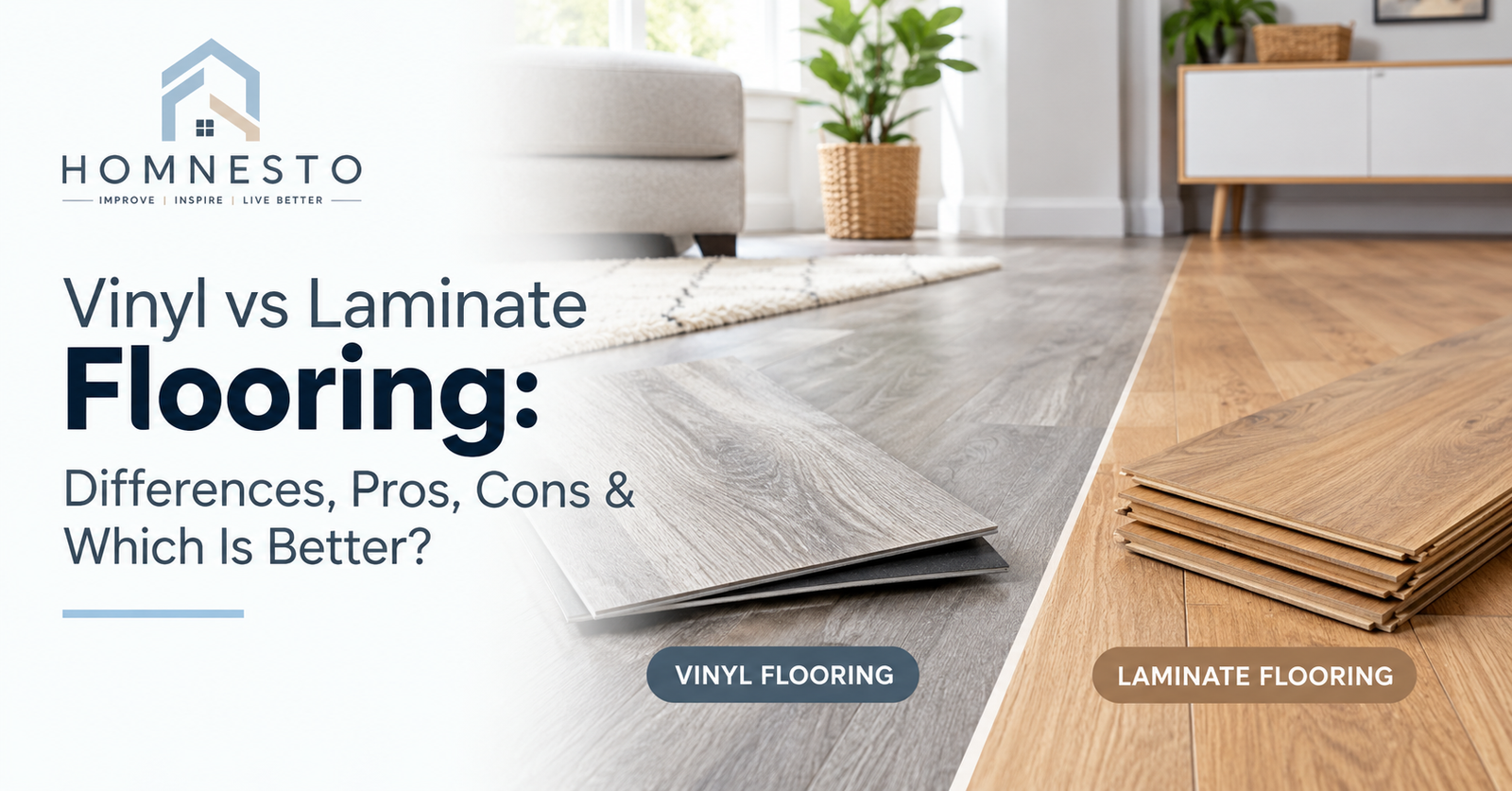

Choosing a new floor can feel harder than it should. Vinyl and laminate can both give a room the look of real wood without the price or upkeep of solid hardwood. However, they are made differently and perform differently in everyday use. That is why homeowners often compare vinyl vs laminate flooring before choosing a material for their home.
The right choice depends on where the floor will go and how the room is used. Water resistance matters in kitchens and bathrooms. Durability matters in busy homes. Cost affects the project budget, while appearance can shape the entire room. Home maintenance, pets, installation, and expected lifespan also deserve attention.
Some homeowners want flooring that can handle spills and pet accidents. Others care more about a realistic wood look or a lower upfront price. Understanding the differences between these two flooring types makes the decision much easier.
Vinyl vs Laminate Flooring: What’s the Difference?
What Is Vinyl Flooring?
Vinyl flooring is a resilient flooring material made primarily from plastic-based layers, commonly including PVC. Modern products can be designed to look like hardwood, stone, or tile while providing a softer feel underfoot.
Vinyl plank flooring is one of the most popular forms. Instead of square tiles, it uses long planks that imitate wood boards. Luxury vinyl flooring takes this idea further with more detailed printed designs, textured surfaces, and thicker construction.
LVP, or luxury vinyl plank, is a type of luxury vinyl flooring made in plank shapes. LVP flooring is widely used for living rooms, kitchens, hallways, bedrooms, and other areas where homeowners want a wood-look floor with strong moisture resistance.
Vinyl flooring can come in several constructions, including flexible sheet vinyl, vinyl tile, and rigid-core plank products. The exact performance depends on the product’s construction and specifications.
What Is Laminate Flooring?
Laminate flooring is a multi-layer flooring product with a decorative image layer over a dense fiberboard-based core. A protective top layer helps resist everyday wear, while the printed design can reproduce the appearance of wood, stone, or other materials.
Laminate plank flooring is designed to resemble individual wood boards. Many products use click-lock systems, allowing planks to connect without nails or glue.
Modern laminate flooring can look very realistic. Better products often have detailed patterns and surface textures that follow the visual grain of the printed wood design.
However, traditional laminate has a wood-based core. That difference becomes important when comparing moisture resistance with vinyl.
Are Vinyl and Laminate the Same?
No. Vinyl and laminate are not the same flooring material.
The difference between vinyl and laminate flooring starts with their basic construction. Vinyl is primarily a plastic-based material, while laminate generally uses a wood-fiber-based core with a decorative surface layer.
This also explains many of the differences in water resistance, maintenance, installation, and performance.
So, if you have wondered is vinyl and laminate the same, is laminate and vinyl the same, or is laminate the same as vinyl, the answer is no. They can look similar, but their construction and behavior are different.
How Are Vinyl and Laminate Flooring Made?
Vinyl flooring usually has several layers. These can include a wear layer, printed design layer, core layer, and backing. Some rigid vinyl products use stone-plastic composite or wood-plastic composite cores.
Laminate flooring also has multiple layers. A typical product includes a protective wear layer, decorative image layer, dense core, and balancing or backing layer.
The manufacturing difference affects how each floor reacts to moisture. Vinyl itself does not absorb water like a wood-based laminate core can. Laminate’s water performance depends heavily on the product’s construction, edge protection, seams, and installation.
Vinyl vs Laminate Flooring: Side-by-Side Comparison
The table below gives a quick vinyl flooring vs laminate comparison. Actual performance varies by product, so always check the manufacturer’s specifications before buying.
| Feature | Vinyl Flooring | Laminate Flooring |
| Water resistance | Excellent on many products; some are waterproof | Varies; water-resistant products are available, but construction matters |
| Durability | Strong resistance to everyday wear and moisture | Strong wear resistance, especially in quality products |
| Cost | Usually moderate and varies by product | Usually moderate and varies by product |
| Installation | Often floating click-lock or adhesive | Commonly floating click-lock |
| Maintenance | Simple; regular sweeping and damp cleaning | Simple, but excess water should generally be avoided |
| Lifespan | Often around 10–25 years depending on product and use | Often around 10–25 years depending on quality and care |
| Appearance | Realistic wood, stone, and tile designs | Very realistic wood and stone designs |
| Comfort | Usually softer and warmer underfoot | Firmer and more wood-like underfoot |
| Pets | Excellent moisture and accident resistance | Can work well, but moisture requires quicker cleanup |
| Kitchens | Very suitable, especially waterproof products | Suitable with appropriate moisture-resistant products |
| Bathrooms | Suitable when specifically rated for wet areas | Product-specific; waterproof-rated laminate is needed |
Vinyl vs Laminate Flooring Pros and Cons
Pros of Vinyl Flooring
Vinyl flooring offers strong moisture resistance, which is one of its biggest advantages. Many modern products can handle spills, wet shoes, and everyday household messes with less concern than traditional wood-based flooring.
It is also available in many designs. Homeowners can find wood-look flooring in different colors, plank widths, textures, and patterns. LVP can provide a particularly convincing hardwood-style appearance.
Vinyl is also relatively easy to clean. It does not require the same type of care as natural hardwood, and many products are suitable for busy households with children and pets.
Installation can be straightforward as well. Many vinyl plank products use click-lock floating installation, although some products require adhesive or other installation methods.
Cons of Vinyl Flooring
Not all vinyl products are equally durable. A thin, low-quality product may show wear sooner than a thicker product with a stronger wear layer.
Vinyl can also be damaged by sharp objects, heavy furniture, or excessive heat. Although many products imitate wood very well, some homeowners may still prefer the natural depth and character of real hardwood.
Another consideration is that vinyl cannot always be repaired in the same way as hardwood. Depending on the product, a damaged plank may need to be replaced.
Pros of Laminate Flooring
Laminate flooring can provide an attractive wood-look surface at a reasonable cost. Modern printing and texturing can make quality laminate look surprisingly close to real wood.
It also performs well against everyday foot traffic. A quality wear layer can help protect the decorative surface from normal household wear.
Laminate plank flooring is often easy to install because many products use click-lock floating systems. This can make installation faster when the subfloor is already suitable.
Another advantage is design choice. Laminate flooring quality has improved significantly, with many products offering realistic grain patterns and finishes.
Cons of Laminate Flooring
Traditional laminate is more sensitive to standing water than vinyl. Moisture that reaches the core or seams can cause swelling, edge damage, or other problems.
Laminate can also be harder to repair when a plank is seriously damaged. Depending on the installation and product, replacing an individual plank may require removing surrounding flooring.
It is also less forgiving in rooms where water regularly reaches the floor. For bathrooms, laundry rooms, and similar spaces, homeowners should look specifically for products rated for those conditions.
LVP vs Laminate Flooring: What’s the Difference?
What Is LVP Flooring?
LVP stands for luxury vinyl plank. It is a type of vinyl flooring made in plank shapes to imitate hardwood.
LVP typically has a printed design layer protected by a wear layer. Many products also have a rigid core and attached or separate underlayment.
The appeal of LVP is the combination of a wood-look appearance, moisture resistance, and relatively simple maintenance. This makes luxury vinyl flooring vs laminate flooring an important comparison for homeowners who want a wood-style floor.
LVP vs Laminate: Key Differences
The main difference between LVP and laminate is their construction. LVP is vinyl-based, while laminate generally has a wood-fiber core.
This affects how the materials respond to water. LVP generally handles moisture better, while laminate requires more attention to water exposure.
Both can provide realistic wood-look designs. Both can also offer click-lock installation and good everyday durability.
When comparing laminate vs LVP, do not look only at appearance. Check the wear layer, core construction, water rating, warranty, installation requirements, and cleaning instructions.
LVP vs Laminate for Water Resistance
For water resistance, LVP generally has an advantage because the vinyl material itself does not have a wood-fiber core that can swell when exposed to moisture.
However, the word “waterproof” should still be checked carefully. Water can reach the subfloor through seams, perimeter gaps, transitions, or installation defects.
A waterproof-rated LVP is usually a strong choice for kitchens, bathrooms, entryways, and other moisture-prone spaces.
LVP vs Laminate for Durability
Both can be durable. The better choice depends on the specific product rather than the material name alone.
For LVP, look at the wear layer and core construction. For laminate, pay attention to the AC rating or other manufacturer-provided durability information where available.
Heavy furniture, pets, grit, and high foot traffic can affect either floor. Good installation and regular cleaning also make a meaningful difference.
LVP vs Laminate for Appearance
Both LVP and laminate can create convincing wood-look floors.
Laminate has traditionally been known for realistic wood patterns, while premium LVP products can now offer detailed textures and designs that closely resemble hardwood.
When comparing luxury vinyl plank flooring vs laminate, look at the actual sample rather than relying only on online photos. Lighting can change how flooring colors and textures appear.
LVP vs Laminate for Maintenance
LVP is generally easier to manage around moisture. Routine care usually involves removing dirt and using a cleaner approved for the product.
Laminate is also relatively easy to maintain, but excessive water should generally be avoided unless the manufacturer specifically permits it.
Is LVP Better Than Laminate?
There is no single answer for every home. LVP may make more sense when moisture resistance, easy cleaning, and pet-friendly performance are priorities.
Laminate may appeal more to homeowners who prioritize a particular wood-look design, surface feel, or product price.
That is why searches such as is LVP better than laminate, is laminate or LVP better, and which is better LVP or laminate need to be answered based on the room and household needs.
Waterproof Laminate vs Vinyl Flooring
Is Vinyl Flooring Waterproof?
Some vinyl flooring products are marketed and tested as waterproof. Waterproof performance depends on the complete flooring system, including seams, joints, installation, and transitions.
Not every vinyl product should automatically be treated as waterproof. Always check the manufacturer’s specifications.
Is Waterproof Laminate Really Waterproof?
Waterproof laminate is designed to provide much better moisture protection than traditional laminate. However, waterproof does not mean the floor can ignore installation requirements or remain submerged indefinitely.
The core, locking system, edges, seams, and installation method all affect real-world performance.
This is why waterproof laminate vs vinyl flooring should be judged using the manufacturer’s water-resistance claims and installation instructions, not just the product’s marketing name.
Waterproof Laminate vs LVP
Both waterproof laminate and waterproof LVP can be used in areas where moisture is a concern, depending on the manufacturer’s rating.
LVP still has an inherent material advantage because vinyl itself is not a wood-fiber core. Waterproof laminate relies more heavily on its construction and protective systems.
For homeowners comparing waterproof laminate vs LVP, the product warranty, installation instructions, edge protection, and permitted rooms are worth checking.
Which Flooring Is Better for Moisture-Prone Areas?
Kitchens can work well with either material when the selected product is suitable for the environment. Vinyl is often attractive because spills are common in kitchens.
Laundry rooms can experience leaks and standing water, so moisture resistance deserves special attention.
Basements can have moisture concerns from humidity or water intrusion. Flooring should be chosen only after the moisture condition of the basement has been addressed.
Entryways regularly receive wet shoes, dirt, and grit. A water-resistant vinyl product can be practical, while properly rated laminate can also work in suitable conditions.
Vinyl vs Laminate Flooring Cost
Is Vinyl or Laminate Cheaper?
There is no universal price winner. Both vinyl and laminate are available at different quality levels, so the final cost depends on the product and installation.
Budget products can be inexpensive, while premium planks with thicker construction, stronger wear layers, better visuals, and more advanced water protection can cost considerably more.
That means is laminate or vinyl cheaper and is vinyl or laminate cheaper are questions that should be answered using actual product and installation prices for the project.
Vinyl Flooring Cost
Vinyl flooring cost depends on the type of product. Sheet vinyl, basic vinyl plank, and premium LVP can have very different prices.
Installation also affects the total. A straightforward floating installation over a prepared subfloor can cost less than a project that requires major preparation or removal work.
Laminate Flooring Cost
Laminate flooring cost also varies by quality. Entry-level products may have simpler designs and thinner construction, while premium laminate can offer more realistic textures, stronger wear layers, and improved moisture protection.
The cost of underlayment, transitions, installation, and floor preparation should be included when estimating the project.
Vinyl vs Laminate Installation Cost
Both can use floating installation systems. However, adhesive-backed vinyl, sheet vinyl, damaged subfloors, uneven surfaces, stairs, transitions, and complicated room layouts can change the labor cost.
A professional installer can also identify preparation issues that may not be obvious before the flooring is removed.
What Affects the Total Flooring Cost?
Material quality is one of the biggest factors. A premium floor can cost much more than an entry-level product.
Room size also matters because larger rooms require more material and labor. Installation costs depend on the product and the complexity of the room.
Underlayment may be required or recommended for some flooring systems. The type of subfloor preparation needed can also add to the budget.
Finally, existing-floor removal can increase labor and disposal costs. If the current floor is suitable for a new floating installation, removal may not always be necessary.
Vinyl vs Laminate Flooring: Durability & Lifespan
Which Flooring Is More Durable?
Laminate can have a very hard wear surface that handles everyday traffic well. Vinyl can provide strong resistance to moisture, impacts, and everyday household use, depending on its construction.
The best choice depends on what the floor will face. Water, pets, heavy furniture, dirt, furniture movement, and foot traffic can all affect performance.
How Long Does Vinyl Flooring Last?
Vinyl flooring can last many years when properly installed and maintained. Product quality, wear-layer thickness, traffic, cleaning practices, sunlight exposure, and installation all affect its lifespan.
The product warranty can also provide useful information about the manufacturer’s expected performance under specified conditions.
How Long Does Laminate Flooring Last?
Laminate flooring can also last many years in the right environment. Its lifespan depends on product quality, traffic, moisture exposure, installation, and maintenance.
A quality laminate installed in a dry living area may perform well for years. Excess moisture, damaged seams, and heavy wear can shorten its useful life.
What Can Damage Vinyl Flooring?
Sharp objects can cut or puncture vinyl. Heavy furniture can cause dents if the weight is not properly distributed. Dragging furniture can scratch the surface.
Excessive heat, harsh cleaning products, and improper installation can also cause problems.
Keeping grit and dirt off the floor helps reduce surface wear because small particles can act like abrasives under shoes.
What Can Damage Laminate Flooring?
Moisture is one of the biggest concerns. Water that enters seams or damaged edges can affect the core.
Heavy impacts can chip the surface, while dragging furniture can scratch it. Excessive moisture during cleaning can also create problems.
If laminate flooring begins to show damaged or peeling edges, addressing the problem early can help prevent further deterioration.
Which Flooring Holds Up Better to Heavy Foot Traffic?
Both materials can work in busy homes, but the product specification matters more than the category alone.
For high-traffic areas, look for a strong wear layer, appropriate warranty, and installation system designed for the intended use.
Commercial-grade products may offer different performance characteristics than products designed only for residential use.
Vinyl vs Laminate Flooring for Pets
Which Is Better for Dogs and Cats?
Flooring for pet owners, vinyl has a practical advantage because of its moisture resistance and easy cleaning.
For many pet owners, vinyl has a practical advantage because of its moisture resistance and easy cleaning.
Laminate can still work well for dogs and cats, particularly in dry rooms where accidents are cleaned quickly. However, repeated moisture exposure can be more concerning for traditional laminate.
The right choice also depends on scratches, nails, traction, and how easily dirt can be removed.
Vinyl Flooring vs Laminate for Pet Accidents
For pet accidents, vinyl is generally easier to manage because the material itself is highly resistant to moisture.
Laminate requires faster cleanup, especially if the product is not specifically designed for strong water resistance.
Which Is More Scratch-Resistant?
Scratch resistance depends heavily on the product’s wear layer and surface construction.
Quality laminate can have a highly durable surface that resists many everyday scratches. LVP can also be highly durable, but sharp pet claws and dragged objects can still mark the surface.
No flooring is completely scratch-proof.
Which Is Easier to Clean With Pets?
Vinyl is generally convenient for homes with pets because it handles moisture and routine cleaning well.
Laminate can also be easy to clean, but it usually requires more careful control of water.
For both materials, regular sweeping or vacuuming helps remove grit before it can scratch the surface.
What Should Pet Owners Look for in Flooring?
Pet owners should look for water resistance, scratch resistance, a durable wear layer, easy cleaning, and a surface that provides reasonable traction.
Color and texture also matter. A heavily patterned wood-look floor may hide small amounts of dirt better than a very smooth, uniform surface. Got a scratch on your vinyl floor? Here’s how you can fix it.
Color and texture also matter. A heavily patterned wood-look floor may hide small amounts of dirt better than a very smooth, uniform surface.
Consider the pet’s size, nails, activity level, and whether accidents are common before making a final choice.
Vinyl vs Laminate Flooring for Different Rooms
Vinyl vs Laminate for Kitchens
Kitchens deal with spills, dropped food, moisture, and heavy foot traffic. Vinyl can be a practical choice because of its water resistance and easy maintenance.
Laminate can also work in kitchens when the selected product is designed for the environment and spills are cleaned promptly.
Vinyl vs Laminate for Bathrooms
Bathrooms require extra care because water can reach the floor frequently. Waterproof vinyl is often a practical option.
Waterproof laminate may also be suitable when specifically rated for bathroom use and installed according to the manufacturer’s requirements.
Vinyl vs Laminate for Living Rooms
Living rooms are generally less demanding from a moisture perspective. Both vinyl and laminate can work well.
The decision often comes down to appearance, comfort, durability, budget, and household activity.
Laminate can provide a firmer, more wood-like feel, while vinyl can offer a slightly softer surface.
Vinyl vs Laminate for Bedrooms
Bedrooms usually have lower traffic and fewer moisture concerns. Both options can work effectively.
Appearance and comfort may carry more weight here than waterproof performance. Underlayment can also influence how a floating floor feels and sounds.
Vinyl vs Laminate for Basements
Basements require careful attention to moisture and humidity. Vinyl is often considered because of its moisture resistance.
Laminate can be suitable when the basement is dry and the product is approved for the conditions.
Vinyl vs Laminate for Entryways
Entryways face dirt, grit, wet shoes, and frequent traffic. Vinyl can be a practical choice because of its moisture resistance.
Laminate can also work, but homeowners should select a suitable product and clean water and grit quickly.
A good entryway mat can help protect either floor by reducing the amount of dirt and moisture brought indoors.
Vinyl vs Laminate vs Hardwood Flooring
How Vinyl, Laminate and Hardwood Compare
Vinyl vs laminate vs hardwood flooring involves three very different materials.
Hardwood is real wood and can often be sanded and refinished. Laminate uses a decorative surface over a manufactured core. Vinyl uses plastic-based layers and can reproduce the look of wood.
The choice depends on budget, moisture exposure, desired appearance, maintenance expectations, and how long the homeowner wants the floor to serve.
Cost Comparison
Hardwood usually has a higher material and installation cost than many laminate and vinyl options, although prices vary widely.
Laminate and vinyl both have budget and premium products, making them flexible choices for different project budgets.
When comparing hardwood vs vinyl vs laminate, consider the entire installed cost rather than the price per box alone.
Water Resistance
Vinyl generally has the strongest moisture resistance of the three, especially when using a product specifically rated as waterproof.
Laminate can have strong moisture protection in newer waterproof products, but construction and installation remain important.
Traditional hardwood is more sensitive to water and can expand, contract, stain, or suffer other damage when exposed to excessive moisture.
Durability and Lifespan
Hardwood can last for decades and may be refinished several times depending on the species and thickness.
Laminate and vinyl can also last many years, but they generally cannot be refinished in the same way as solid hardwood.
Actual flooring lifespan depends on product quality, traffic, moisture, installation, and maintenance.
Maintenance Requirements
Vinyl usually needs routine sweeping and product-approved damp cleaning.
Laminate also needs regular dust and dirt removal, but excess water should generally be avoided unless the manufacturer says otherwise.
Hardwood requires more careful moisture control and cleaning practices. Surface scratches can sometimes be repaired or refinished.
Appearance and Wood-Look Options
Hardwood offers genuine wood grain, natural variation, and the ability to develop character over time.
Laminate can provide highly detailed wood-look patterns at a lower cost than many hardwood options.
Vinyl can also provide realistic wood-look flooring, including textured LVP products. This makes vinyl wood flooring vs laminate a useful comparison when appearance and moisture resistance both matter.
Laminate vs Linoleum vs Vinyl Flooring
Laminate vs Linoleum
Laminate and linoleum are different materials. Laminate generally uses a decorative surface over a fiber-based core, while genuine linoleum is traditionally made from materials such as linseed oil, wood or cork-based components, and natural fillers.
Linoleum is known for resilience and long service life when properly maintained. Laminate is often chosen for its wood-look appearance and easy floating installation.
Linoleum vs Vinyl
Linoleum and vinyl are sometimes confused because both are resilient flooring products. They are not the same material.
Vinyl is plastic-based, while traditional linoleum is made from natural raw materials.
Vinyl usually offers more water-resistant options and a broader range of printed designs. Linoleum has its own durability and sustainability characteristics that appeal to some homeowners.
Laminate vs Vinyl
The biggest difference between laminate vs vinyl is the core material. Vinyl is plastic-based, while laminate typically uses a wood-fiber core.
That difference affects water resistance, cleaning requirements, and where each flooring type is most practical.
How Their Cost, Durability and Water Resistance Compare
Cost varies widely across all three materials. Entry-level and premium products can differ significantly.
Vinyl generally provides strong water resistance, while laminate varies from traditional moisture-sensitive products to newer waterproof designs.
Linoleum can be durable and long-lasting when properly maintained, but it has different care requirements from vinyl.
Laminate vs Vinyl Tile Flooring
What Is Vinyl Tile Flooring?
Vinyl tile flooring is a vinyl-based product made in square or rectangular tile formats. It can imitate stone, ceramic tile, or other surfaces.
Some vinyl tile products use adhesive installation, while others may use different systems depending on the product.
Laminate vs Vinyl Tile: Key Differences
Vinyl tile is moisture-resistant depending on the product, while laminate has traditionally been more sensitive to water.
Laminate usually comes in plank or sometimes tile-like formats and is often installed as a floating floor.
Vinyl tile can provide more flexibility in design and installation, particularly when creating patterns.
Vinyl Tile vs Laminate for Water Resistance
Vinyl tile generally has an advantage when water resistance is important because vinyl itself does not contain the same wood-fiber core found in traditional laminate.
However, seams and installation still matter. Water can move through gaps or poorly sealed areas.
Vinyl Tile vs Laminate for Durability
Both can be durable enough for everyday residential use.
Laminate can have a hard protective surface that resists normal wear. Vinyl tile can offer good resistance to moisture and everyday use, depending on the wear layer.
Which Is Easier to Install?
Installation depends on the specific product.
Click-lock laminate is often straightforward for floating installations. Some vinyl tiles use peel-and-stick or adhesive systems, while other products have different installation requirements.
How to Tell If Your Floor Is Laminate or Vinyl
How to Tell the Difference Between Vinyl and Laminate Flooring
The easiest way to identify an existing floor is to look at its construction, surface, edges, and response to moisture.
Appearance alone is not always enough. Modern vinyl and laminate can both look remarkably similar.
The difference between laminate and vinyl flooring is often easier to identify from a cut edge or exposed plank than from the top surface.
Check the Surface and Texture
Run your hand across the floor. Vinyl often has a slightly softer or more resilient feel, while laminate can feel harder and more rigid.
However, texture varies by product, so this test is not conclusive by itself.
Check the Plank Construction
If you can safely inspect an exposed edge, look at the core.
Laminate commonly has a dense, fiber-based core. Vinyl may have a flexible or rigid plastic-based core, depending on the product.
This is one of the more reliable ways to identify the flooring.
Check the Floor’s Water Resistance
Do not intentionally flood an unknown floor to identify it.
Instead, consider how the floor has performed around normal spills and moisture. Water damage around seams can provide clues, but it does not prove the material type.
Manufacturer labels, leftover packaging, or product records are more reliable sources.
Check the Edges and Installation Method
Click-lock systems can be used by both vinyl and laminate, so the installation method alone does not identify the floor.
Look at exposed transitions, vents, closets, or areas where a plank edge may be visible.
Is My Floor Laminate or Vinyl?
If you are still unsure, check the original product documentation or ask a flooring professional to inspect an exposed edge.
A professional can usually identify the material without damaging the floor.
Can You Put Laminate Flooring Over Vinyl?
Can You Lay Laminate Flooring Over Vinyl?
Laminate can potentially be installed over existing vinyl when the vinyl is firmly attached, the surface is clean and stable, and the subfloor meets the laminate manufacturer’s requirements.
The condition of the existing floor matters more than simply knowing it is vinyl.
When Can Laminate Be Installed Over Vinyl?
Laminate may be installed over vinyl when the existing flooring is secure, flat, dry, and free from major damage.
The manufacturer’s installation instructions should be followed because some products have specific requirements about existing flooring and underlayment.
What Should You Check Before Installation?
Check for loose areas, bubbling, moisture, major seams, soft spots, uneven sections, and damage.
The floor should also be sufficiently flat for the new laminate. Small imperfections may be manageable, but major unevenness can affect the locking system.
When Should You Remove Existing Vinyl?
Existing vinyl should generally be removed when it is loose, damaged, uneven, contaminated by moisture, or otherwise unsuitable as a stable base.
Removal may also be necessary when the manufacturer specifically requires it.
Older flooring can require additional safety considerations, so professional advice may be appropriate before disturbing unknown materials.
How to Prepare the Floor for Laminate Installation
Clean the existing surface thoroughly and repair or remove unstable areas.
Check the subfloor for moisture and levelness. Address problems before installing the new floor.
Use the underlayment specified for the laminate product. Do not assume that adding extra underlayment will always improve performance because excessive softness can affect some locking systems.
Vinyl vs Laminate Flooring: Cleaning & Maintenance
How to Clean Vinyl Flooring
Start by removing loose dirt, dust, and grit with a soft broom or vacuum suitable for hard floors.
Use a damp mop and a cleaner approved by the flooring manufacturer. Avoid harsh chemicals or excessive water unless the manufacturer specifically permits them.
How to Clean Laminate Flooring
Regularly remove dust, dirt, and grit with a soft broom or suitable vacuum.
Use a lightly damp cleaning method when permitted by the manufacturer. Avoid leaving standing water on the surface.
Which Flooring Is Easier to Maintain?
Both vinyl and laminate are relatively easy to maintain compared with many traditional flooring materials.
Vinyl generally has an advantage where moisture and frequent spills are concerns.
Laminate can be very simple to maintain in dry rooms, provided excess water is avoided and spills are cleaned promptly.
How to Prevent Scratches, Stains and Water Damage
Use felt pads under furniture and lift heavy pieces instead of dragging them.
Place mats at exterior doors to reduce dirt and grit. Clean spills quickly, especially on laminate.
Trim pet nails regularly and keep sharp objects away from the floor. Follow the manufacturer’s cleaning instructions rather than using a product simply because it is marketed for floors.
If laminate edges begin peeling or separating, address the problem early rather than allowing moisture and traffic to make the damage worse.
PVC Flooring vs Vinyl vs Laminate
Is PVC Flooring the Same as Vinyl?
PVC flooring and vinyl flooring are closely related terms because PVC, or polyvinyl chloride, is the primary plastic used in many vinyl flooring products.
In everyday flooring discussions, “PVC flooring” may be used to describe products that would commonly be sold as vinyl flooring.
However, product construction can vary, so specifications should be checked before comparing two products.
PVC vs Laminate Flooring
PVC-based flooring generally offers strong moisture resistance. Laminate relies on its core and protective construction and can be more sensitive to moisture depending on the product.
How PVC Compares With LVP
LVP is itself a type of vinyl flooring, so many LVP products contain PVC.
The important difference is that LVP describes a specific plank-style luxury vinyl product rather than simply referring to the plastic material.
How to Choose Between Vinyl and Laminate Flooring
Choose Vinyl If Water Resistance Is a Priority
Choose vinyl when spills, wet shoes, pet accidents, or regular moisture are major concerns.
Waterproof-rated LVP can be particularly useful in homes where homeowners want wood-look flooring without the same moisture concerns associated with traditional laminate.
Choose Laminate If Appearance Is a Priority
Laminate can be an attractive option when the main goal is a realistic wood appearance and a firm, wood-like feel.
Modern laminate flooring quality varies significantly, so compare actual samples rather than choosing only by online photographs.
Choose Vinyl for High-Moisture Areas
Vinyl is often a practical choice for kitchens, bathrooms, laundry rooms, basements with appropriate moisture conditions, and entryways.
Choose Laminate for Dry Living Spaces
Laminate can work particularly well in dry living rooms, bedrooms, dining areas, and other spaces where moisture is limited.
A quality product can provide strong wear resistance and an attractive wood-look finish.
Consider LVP for Wood-Look Flooring
If you want wood-look flooring but also want strong moisture resistance, LVP deserves consideration.
Consider Your Budget, Pets and Maintenance Needs
Start with the way your household actually uses the room. Also consider your installation budget, expected traffic, cleaning habits, and how long you expect to keep the floor.
Frequently Asked Questions About Vinyl vs Laminate Flooring
Is Vinyl Flooring Better Than Laminate?
Neither material is automatically better for every home.
Vinyl can be a strong choice when water resistance, easy cleaning, and pet-friendly performance are priorities. Laminate can appeal to homeowners who prioritize a particular appearance, feel, or dry-room application.
Is Laminate Flooring Better Than Vinyl?
Laminate can be a good option for dry areas where homeowners want a realistic wood-look surface and strong everyday wear resistance.
Vinyl may be more practical where moisture is a concern.
Is LVP Better Than Laminate?
LVP can offer strong moisture resistance, easy maintenance, and realistic wood-look designs.
Laminate can offer a hard, wood-like surface and a wide selection of designs.
Is Vinyl or Laminate Cheaper?
Both have low-cost and premium options. The material price alone does not determine the total project cost.
Installation, subfloor preparation, underlayment, room size, and existing-floor removal can all change the final flooring cost.
Which Lasts Longer, Vinyl or Laminate?
Both can last for many years when installed correctly and maintained properly.
Which Is More Waterproof, Vinyl or Laminate?
Vinyl generally has an advantage because the material itself is highly resistant to water.
Waterproof laminate has improved considerably, but its performance depends on the complete product construction and installation.
Always check the manufacturer’s waterproof rating rather than assuming every product in a category has the same protection.
Is Vinyl or Laminate Better for Pets?
Vinyl is often practical for pets because it handles moisture and accidents well and is easy to clean.
Laminate can also work in pet-friendly homes, particularly in dry areas where accidents are cleaned quickly.
The product’s scratch resistance and surface texture should also be considered.
Is LVP the Same as Laminate?
No. LVP is luxury vinyl plank flooring, while laminate is a separate flooring category.
Both can imitate hardwood, but their core materials and moisture behavior are different.
Is Laminate Flooring Good?
Yes, laminate can be a practical flooring choice when it is matched to the right room and installed correctly.
It can provide good appearance, everyday durability, and relatively simple installation and maintenance.
Can You Put Laminate Flooring Over Vinyl?
Sometimes. Can you put laminate flooring over vinyl flooring or can you put laminate over vinyl flooring depends on the condition of the existing vinyl, the subfloor, moisture levels, flatness, and the laminate manufacturer’s installation requirements.
If the existing vinyl is stable, clean, dry, and sufficiently flat, an overlay installation may be possible. If it is damaged, loose, uneven, or affected by moisture, removal may be necessary.