


Water lines for a house carry clean water from a municipal connection or private well to the fixtures and appliances that use it. A typical system includes a service line, a main shutoff, interior distribution piping, and separate hot and cold branches. Understanding how these parts fit together helps homeowners identify the main water line, recognize warning signs, and know when a licensed plumber should investigate. This overview explains home water lines, common pipe materials, sizing considerations, and the difference between supply pipes and drains.
How Do Water Lines Work in a House?
In a municipal system, water usually travels from a public main through a service line and meter before entering the property. A private-well system instead draws water through a pump and related equipment; the exact arrangement depends on the well and treatment setup. After entering the home, water supply piping distributes cold water to fixtures and to the water heater. Hot water then travels through separate branches to sinks, showers, and appliances that require it.
Supply pipes carry pressurized clean water toward fixtures. Drain-waste-vent pipes carry used water away by gravity or through a drainage system and are not interchangeable with supply piping. A domestic water line may serve the whole home or a particular branch, depending on where it sits in the system.
What Are the Different Types of Water Lines in a House?

The names describe a line’s job in the system, not necessarily the material it is made from. A home can have a main service connection, distribution mains, branches, and short fixture connections.
Main Water Supply Line
The main water supply line brings water into the home’s plumbing system from the utility service or a private-well pressure system. The main water line in house terminology can refer to the exterior service line or the interior pipe after entry, so clarify which section is being discussed before arranging work.
Cold Water Lines
Cold lines supply drinking-water taps, toilets, outdoor faucets, and other fixtures. A branch also supplies the water heater, where water is heated before being sent through the hot-water network.
Hot Water Lines
Hot lines carry heated water from the water heater to fixtures and appliances that need it. The route and number of branches vary with the home’s layout, water-heating equipment, and whether a recirculation system is installed.
Branch Water Supply Lines
Branch lines split from larger distribution pipes and serve a room, group of fixtures, or individual fixture. Their size and routing are selected according to demand, pipe length, pressure available, and applicable code not just the number of rooms.
Fixture Water Supply Lines
Short fixture supply connections link shutoff valves to sinks, toilets, dishwashers, washing machines, and similar equipment. Flexible connectors make servicing easier, but they still need to be compatible with the fixture, pressure, temperature, and local requirements.
Where Does the Main Water Line Enter a House?
The entry point depends on the age and construction of the property, the utility’s service arrangement, and whether the home uses a well. Keep the exterior service line, interior supply piping, meter, and shutoff valve distinct: they are related components, but they are not the same thing.
Water Line From the Street to the House
For a municipal connection, the water line from street to house typically runs from the public water main toward the property. Responsibility for the service line can be divided between the utility and property owner; check the local utility’s rules before arranging excavation or repairs.
Water Line From the Meter to the House
A water line from meter to house may run from a meter located in a pit, box, basement, or another approved location to the building entry. Some homes have different meter placements or service layouts, so use utility records or a plumber’s assessment instead of assuming a standard route.
How to Find the Main Water Line Inside Your House
Start where the service appears to enter the building. Look in a basement, crawl space, utility room, garage, or near a foundation wall, depending on the home’s design. If you are wondering how to find the main water line into the house, follow visible piping only where accessible and avoid drilling, cutting, or excavating to trace a hidden line. For the question ‘where is the main water line in my house,’ the utility or a licensed plumber may be able to confirm the entry location.
How to Locate the Main Water Shut-Off Valve
The main shut-off valve is often close to where the service line enters the building, but it may be elsewhere in a utility space or near the meter. Identify it before an emergency and keep access clear. If the valve is corroded or will not turn easily, do not force it; ask a plumber to inspect it.
A main water line to house diagram can be useful when identifying the service route, but actual layouts vary by property. The exterior main water line to house and the main water supply line to house may also have different ownership or maintenance responsibilities.
What Is the Typical Water Line Layout in a House?
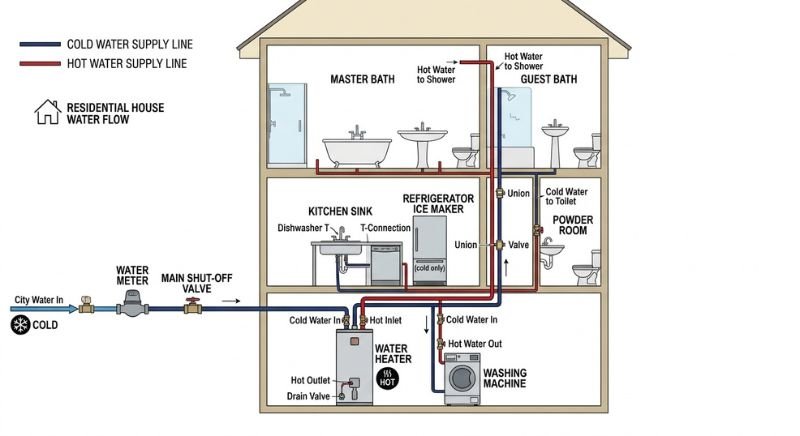
Water lines may run through walls, floors, basements, crawl spaces, or utility chases. In some houses, a trunk-and-branch layout sends larger pipes toward smaller branches; manifold systems may use separate runs from a central distribution point. The right arrangement depends on the building and design.
How Water Supply Lines Are Routed Through a Home
Installers plan routes to reach fixtures while limiting unnecessary bends, protecting pipes from damage, and allowing access to valves and service points. Concealed routing can look tidy, but it makes early leak detection more difficult, which is why visible warning signs deserve prompt attention.
How Hot and Cold Water Lines Are Arranged
Hot and cold water lines usually run as separate networks. Cold water goes directly to cold-water fixtures and to the water heater; hot water piping then carries heated water to the fixtures that need it. The exact hot and cold water piping arrangement varies with the building’s size and plumbing design.
How Water Lines Connect to Bathrooms and Kitchens
Bathrooms commonly have hot and cold connections for sinks and showers, a cold supply for toilets, and sometimes connections for tubs or bidets. Kitchens often have a sink, dishwasher, refrigerator ice maker, and other appliances. Each connection should have suitable fittings and accessible shutoffs where required.
Understanding a Residential Water Line Diagram
Use the simplified diagram below as a conceptual guide, not as a construction drawing. A main water line to house diagram should identify the source, meter where present, main shutoff, cold distribution, water heater, hot distribution, and fixture branches. A private well has a different source arrangement from a municipal service.
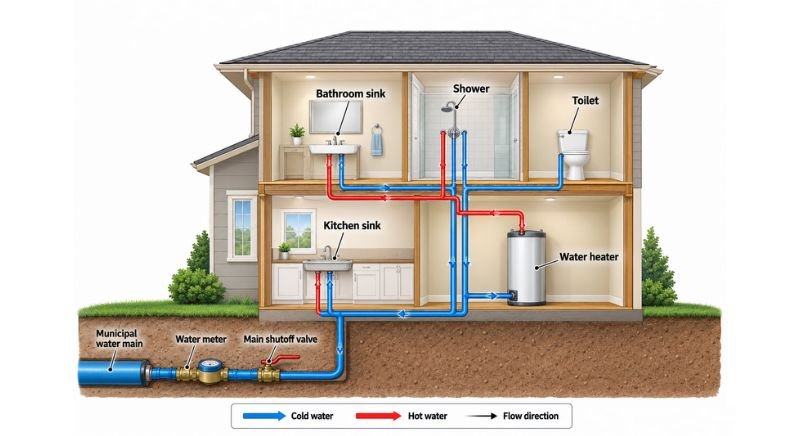
A well system may include a pump, pressure tank, treatment equipment, and other components before the home’s distribution piping. This simplified diagram is not universal.
What Size Water Line Does a House Need?
There is no single water pipe size for a house that fits every property. Pipe sizing depends on expected fixture demand, available supply pressure, pipe length, fittings, elevation, material, and the applicable plumbing code. A qualified plumber or plumbing designer should calculate the size rather than selecting it from house size alone.
Common Main Water Line Sizes for Residential Homes
Residential service lines are often discussed in nominal sizes such as 3/4 inch or 1 inch, but these are examples, not a universal recommendation. The adopted code and local utility requirements determine the acceptable design. The 2024 International Plumbing Code includes sizing provisions based on required demand and pressure; local jurisdictions may adopt different editions or amendments.
How to Choose the Right Water Supply Line Size
A water supply line size calculation considers simultaneous fixture use, developed pipe length, meter and fitting losses, elevation changes, available pressure, and the material’s internal diameter. The supply line and interior branches may require different sizes. Have the design checked against local code and utility specifications.
How Pipe Size Affects Water Flow and Pressure
A smaller or longer pipe can create greater friction loss at a given flow, while larger pipe is not automatically a cure for low pressure. Pressure at the source, partially closed valves, clogged components, leaks, elevation, and demand can all affect performance.
When Should a Home Water Line Be Resized?
A professional may assess resizing when several fixtures lose flow during simultaneous use, a renovation adds demand, or an existing line is undersized, deteriorated, or poorly configured. Confirm the cause first; a pressure complaint alone does not prove that the pipe diameter is wrong.
What Types of Pipes Are Used for House Water Lines?
Water pipes in house may be metal or plastic, and each product has limits for temperature, pressure, installation method, and approved use. Select household water pipes that are certified for drinking-water contact where required and permitted by the local code. Do not assume a pipe suitable for drainage is also suitable for potable water.
PEX Water Supply Pipes
PEX is flexible and commonly used for hot and cold water distribution in residential construction and remodeling. It can reduce the number of fittings needed around turns, but it must be protected from conditions that the product does not allow, including unsuitable UV exposure, temperatures, or installation environments.
Copper Water Pipes
Copper is a durable, rigid option used in many existing homes and new installations. It requires compatible fittings and skilled joining, and water chemistry matters: acidic water can increase copper corrosion and leaching. Consider the water quality and local installation conditions before choosing it.
CPVC Water Pipes
CPVC products are used for approved hot- and cold-potable-water applications when the product is rated for the intended temperature and pressure. Correct solvent cement, installation technique, support, and code compliance matter; follow the manufacturer’s instructions.
PVC Pipes and Their Appropriate Uses
PVC is widely used for drainage and other applications, and certain products are approved for specific cold-water pressure applications. Standard PVC should not be assumed suitable for hot-water service. Confirm the exact product’s potable-water certification, pressure rating, temperature limits, and local code before using it.
How to Choose a Pipe Material for Indoor and Underground Water Lines
Compare intended use, water temperature, operating pressure, UV and soil exposure, joining method, water chemistry, repair access, product certification, and code requirements. A water supply pipe installed underground must be specifically approved for that use. The best material depends on the application rather than a universal ranking.
| Material | Common suitability | Limitations to check |
| PEX | Approved hot and cold potable-water systems; flexible indoor runs | UV exposure, product temperature/pressure ratings, fittings, local approval |
| Copper | Hot and cold supply; visible or concealed rigid piping | Water chemistry, joining skill, corrosion risk, material and labor cost |
| CPVC | Approved hot and cold potable-water systems | Temperature/pressure ratings, compatible cement, installation requirements |
| PVC | Some approved cold-water pressure applications; commonly drainage | Do not assume standard PVC suits hot water; verify potable-water and pressure approval |
How Deep Should a Water Line Be Buried?
The required depth depends on climate, frost penetration, line type, soil conditions, utility specifications, and local rules. Do not use a single online depth as a universal installation instruction. Before digging, contact the local utility locating service and confirm the permitted route and requirements.
Typical Underground Water Line Depth
The question ‘how deep does a water line need to be’ cannot be answered accurately without a location and line type. Municipal service lines, private water services, and other buried piping may be governed by different requirements. Utility guidance and adopted code should control the project.
How Frost Depth and Climate Affect Water Line Installation
In freezing climates, burial depth and other freeze-protection measures are intended to reduce the risk of frozen service lines. Local frost depth varies substantially, and shallow sections near foundations or exposed transitions may need particular attention. If a line freezes, avoid open flames and consult a qualified professional.
Local Plumbing Codes and Underground Water Line Requirements
Before installation or replacement, check the local plumbing code, utility requirements, permits, separation rules, and the required pipe material. Never excavate before arranging required underground utility marking. A licensed plumber can confirm the correct depth and route for the property.
What Are the Common Problems With Water Lines in a House?
Problems can appear as visible moisture, changes in flow, discolored water, or deterioration on exposed piping. These signs help guide an investigation but do not always identify the cause on their own.
Leaking Water Supply Lines
Look for damp cabinets, water stains, corrosion near joints, unexplained wet spots, or an unusual increase in water use. A hidden leak may not be visible at the pipe itself. Shut off the relevant supply if safe and get professional help for active, concealed, or recurring leaks.
Low Water Pressure Throughout the House
Whole-home pressure changes can result from supply restrictions, a partially closed valve, a leak, clogged components, pressure-regulating equipment, or a utility-side issue. Low pressure alone does not confirm damaged pipes. If only the shower is affected, this [guide to low shower water pressure] can help narrow down possible causes.
Discolored Water or Changes in Water Flow
Water that suddenly appears brown, yellow, or cloudy can have several causes, including utility work, sediment, corrosion, or a local plumbing issue. Follow local water-provider notices and seek advice if the change persists, returns, or is accompanied by an unusual taste or odor. Do not assume appearance alone establishes whether water is safe to drink.
Corroded or Damaged Water Pipes
Visible pitting, flaking, bulges, cracks, or repeated leaks may indicate deterioration. Do not scrape, cut, or dismantle a damaged line to inspect it. Photograph the area and have a plumber evaluate the condition and extent of damage.
When Should Water Lines Be Repaired or Replaced?
Repair or replacement depends on the location, pipe material, age, condition, and extent of the problem. A localized connection failure may need a limited repair, while widespread deterioration or repeated failures may justify evaluating a larger section.
Common Reasons Water Supply Lines Need Repairs
Leaks, loose or damaged connections, corrosion, accidental damage, and failing flexible connectors are common reasons to arrange repair. The correct solution should address the cause, not just the visible moisture.
Signs a Main Water Line May Need Replacement
Repeated service-line leaks, extensive corrosion or damage, persistent unexplained water loss, and recurring supply problems may prompt a replacement assessment. These signs do not automatically mean the entire line must be replaced; testing and inspection help establish the scope.
When to Call a Licensed Plumber
Call a qualified plumber for concealed leaks, significant pipe damage, underground service-line concerns, repeated pressure problems, or any work that requires cutting into walls or excavating. Ask the utility who is responsible for the affected section before authorizing work. Detailed main water line installation and water supply line replacement should follow local permits, code, and utility requirements—not improvised DIY steps.
FAQs About Water Lines in a House
What Is the Main Water Line in a House?
It is the service or primary supply pipe that brings water from the utility connection or private-well system into the home’s plumbing. People may use the term for either the exterior service line or the interior main pipe, so context matters.
How Many Water Lines Does a House Have?
There is no fixed number. A home has a main supply connection plus a network of cold-water, hot-water, branch, and fixture lines, and the total depends on the number of fixtures, layout, and equipment.
What Size Water Line Is Common in a Residential Home?
Some homes use service lines such as 3/4-inch or 1-inch nominal pipe, but these examples are not a sizing rule. The required size depends on demand, available pressure, pipe length, fittings, code, and utility requirements.
Are Hot and Cold Water Lines Separate?
Yes, in a typical home they are separate supply networks. Cold water serves cold fixtures and the water heater; hot water then travels from the heater through its own piping to fixtures that need it.
How Deep Is a Water Line Buried?
It varies by location, climate, frost depth, utility rules, and the type of line. Check local requirements and utility guidance before planning excavation or installation.
How Can I Find the Main Water Line in My House?
Look for the service entry near a foundation wall, basement, crawl space, garage, or utility room, then locate the main shutoff valve. If piping is concealed or the route is unclear, ask the utility or a plumber to help identify it.
How Long Do Residential Water Lines Last?
Service life varies by material, water chemistry, installation quality, pressure, soil conditions, and maintenance. There is no single lifespan that applies to every home water line; a plumber can assess visible condition and repair history.
Conclusion
Understanding water lines in house plumbing helps homeowners recognize the main supply route, distinguish hot and cold branches, and make informed decisions about pipe materials, sizing, and maintenance. Identify the main shutoff valve, keep records of recurring issues, and confirm local requirements before any underground work. For significant leaks, damaged service lines, or persistent pressure changes, a licensed plumber can determine whether repair, replacement, or further testing is appropriate.
- For more practical plumbing guidance, see related articles:
If a water heater makes a new sound, learn about a noisy water heater. - In freezing weather, review safe steps for frozen pipes.
- For broader symptoms, consult the home plumbing troubleshooting guide.
- For related fixture issues, see guidance on a running toilet, a slow sink drain, a leaky faucet handle, and a clogged bathtub drain.